
From “Occassional links and Commentary” by David F Ruccio
The Value[s]of Art by David F Ruccio
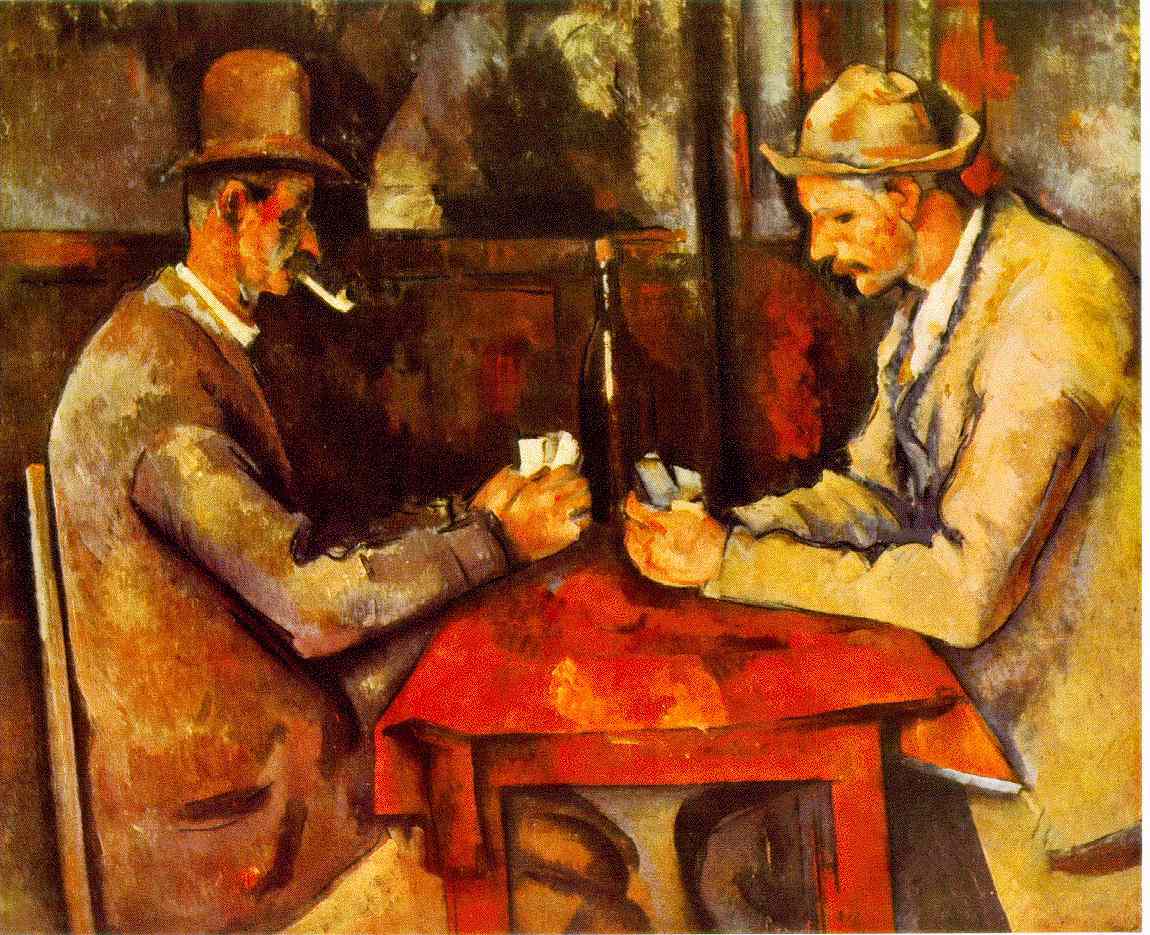
Paul Cézanne, “The Card Players” (c. 1890-92)—$250 million at auction
What is the value of art?
Felix Salmon, in arguing that art is not a good financial investment, analyses the current art market and presents a theory of the value of art:
The whole point of art is that it has no intrinsic value: that its financial value is a magical number which is some highly variable function of how much various incredibly rich people love and covet the work.
But she’s [meaning Sarah Thornton] right about this aspect of why the two big auction houses are doing so well these days:
Christie’s and Sotheby’s are superlative marketers who are getting better at funnelling demand for objects by a small group of well-tested artist brands.
The key word here is “brands”. CNBC’s Zac Bissonnette recently wrote to me saying that what he hates about contemporary art is the way in which “you can just put it there and all your friends will know what it is. People might as well hang a Nike swoosh over their couches.”
Zac’s exactly right about this: the one thing that pretty much all ultra-expensive art has in common is that it’s instantly recognizable as the work of a given artist. (And that goes for Cézanne as much as it does for Jeff Koons.) Fine art has become the billionaire’s-club equivalent of a Louis Vuitton bag, slathered in logos. It’s not connoisseurship which drives values, so much as recognizability. Which in turn helps to explain why the most prolific artists (Picasso, Warhol, Hirst) are also the most expensive: the more of their work there is, the more exposed to it people become, the more they’ll recognize it, and therefore the more desirable it is.
I do hold out some small hope that the Chinese art market will provide a correction to this syndrome — there, I’m told, the value of an art work is (at least sometimes) much less a function of its recognizability as the work of a certain artist, and much more a function of the way that it can fit itself into a long artistic tradition.
I want to make just three quick comments: First, art may not have an “intrinsic value” but which commodities do? Is Salmon invoking some kind of labor theory of value here? Second, precisely because paintings and other works of art are status or Veblen goods, their prices affect the desires of wealthy individuals to purchase them. And third, it is precisely because the art market is now governed by a different group of rich people, e.g., from China, the values of different kinds of art are changing and are likely to continue to change in coming years.
Yes, rich people around the world are buying famous paintings and other works of art, not because they’re a good financial investment or because of their intrinsic value but because they can own them and show to the world that they can and do own them.
David F. Ruccio | 9 February 2012 at 10:37 am
 Peteskibreen's Blog