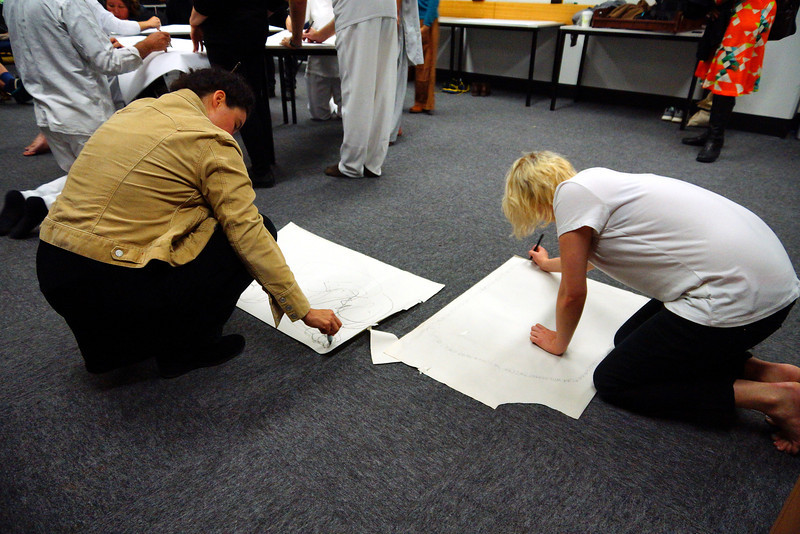
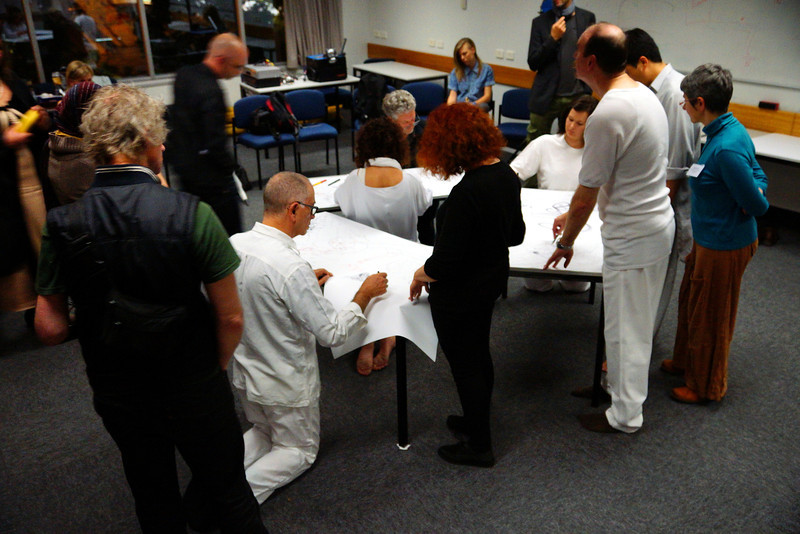
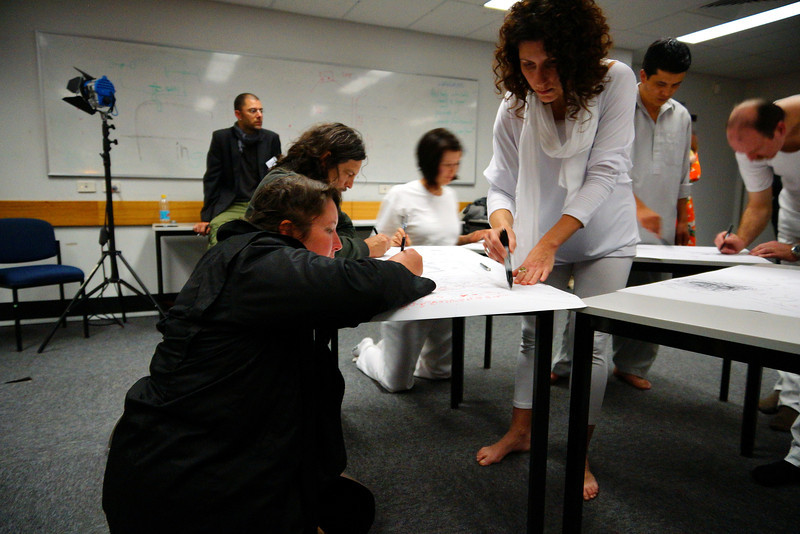
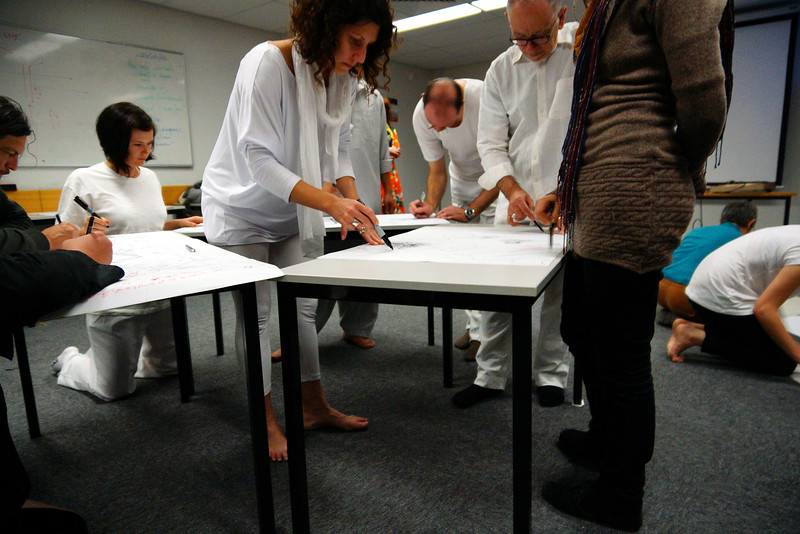
This is an edited version of my paper at the Exist-ence 5 conference at QCA delivered on June 26 and followed up with an installation on Level 6 on the same day. Attached images are of that installation. Thanks to Mel Davis, Paul Harris, Lisa De Re , Sha Sarwari and Lucy Forsberg. [Participants] and various conference observers who slowly became willing extra performers! Photo credits Alan Warren.
exist-ence 5: international festival and symposia
live art, performance art and action art
Performance, the Body and Time in the 21st century
June 26-27 Brisbane exist & QCA Project Gallery
White Silence
Peter Breen MA [Creative Arts Therapies], BTh, ARMIT, MIR
Do threshold moments or liminality or theophany arrive within a contrived time space performance installation?
INTRODUCTION
Why we are in the arts is a lifelong reflection.
What work we do is dictated by forces beyond us even if we fall on our feet and are full of a sense of call and destiny. Few have the luxury of a life of long reflective walks where –says Nietzsche – good ideas come to us.
From the day we leave our tertiary training institutions or otherwise, the battle is on for the sale of our work, for positions in theatre and performance, for studio space and for the energy and vision to pursue what we thought we were called to be and what we passionately want to do.
We are not as altruistic as the social worker or health worker – artists have fun, reflect angst, make our own beauty and try and conquer the occasional moments of doubt and depression.
But the arts are society’s medicine. As aboriginal dancer and choreographer, Stephen Page said “The great medicine for humanity is art” and Simon and Garfunkel sang in the 1960’s “The words of the prophets are written on the subway walls.” Along with a range of qualitative research and intuitive knowing in artists including Kandinsky’s 1914 essay “Concerning the spiritual in art” this implies that in and through our practice there is a spiritual force, perhaps unseen or slow to emerge – but there. It is critical that this spirituality be free in us if we are to be medicinal prophets, if we are to be more than just 9- 5 artists and if we are to be more than accomplished and successful.
Does this imply that only the truly gifted can be medicine and prophet? Yes and no. We find our place as artists in the hard work and struggle against our own poverty and in the hard work and occasional rejection that finally confirms or redirects our talent until we find our rhythm and flow. Most of us will add and subtract various practices and disciplines over our life but even in dissonance and disappointment hopefully we find a place where we are true to ourselves and our gift.
Does this imply that we can’t have fun and that we are to be full of intensity as we are so often the first to see and reflect the injustices of the world we live in? Yes and no. Once we manage to free ourselves from being only market driven and find our voice, we will develop balance around intensity and fun in our practice.
The idea of a spiritual element to our lives, calling and arts practice might sound irrational and decidedly impractical and certainly not economically productive but I am totally convinced of its presence in all of us and that it can be nurtured. To leave it undeveloped impoverishes our lives and our art.
So what leads us to be artists? What keeps us at it? What value does art have in the scheme of our living?
South African artist William Kentridge has something to say on this: “So what was it that led Kentridge into art? What possibilities did he see in it? And how did he justify art-making when, in his own country, people were being locked up, tortured, murdered, exploited and spiritually crushed as a direct result of government policy? In a formulation that sounds almost like a pointed rebuke to the law, Kentridge has said he saw art as “a way of arriving at knowledge that is not subject to cross-examination”. Kentridge makes up his animated films as he goes along. His motto when making them, he claims, is ‘NO SCRIPT, NO STORYBOARD’. And his art flouts the first rule of cross-examination: that you know in advance the answer to every question you ask. Elsewhere he has spoken of the “seriousness of play”, claiming that “it’s always been in between the things I thought I was doing that the real work has happened”.[i]
Kentridge and Kandinsky inspire me to pursue the in between, the third way, the road less travelled, the vision of who I am.
Bruce Wilson in “Reasons of the Heart” talks about Australian novelist and Nobel Prize winner Patrick White’s epiphany – a kind of in-between experience : “During what seemed like months of rain, I was carrying a tray load of food to a wormy litter of pups down at the kennels when I slipped and fell on my back, dog dishes shooting in all directions. I lay where I had fallen; half blinded by rain, under a pale sky, cursing through watery lips a God in whom I did not believe. I began laughing, finally, at my own helplessness and hopelessness, in the mud and stench from my filthy old oilskin. It was the turning point. My disbelief appeared as farcical as my fall. At that moment, I was truly humbled.”[ii]
In the pursuit of our art, in our practice, in our experiencing, are there moments when we sense another dimension, another voice, another vision?
Do we find a cupboard door opening into the mysterious in the creative silent moments between the lines, between the breathless final curtain call and the change room?
Are there non drug induced existential and almost inexplicable non-diarised moments that arrive at some point for us as artists, as people passionate about our practice in our practice and during our practice?
Are there moments that arrive for us that bring new intuitive poetic meanings and that are concurrent with or above or more than dissonance or exhilaration – a kind of “feather on the breath of God” and that are motivational for the rest of our lives or at least for the next chapter of our lives?
Which begs the question again:
What indeed are we doing art for?
William Kentridge again:
“Often, the finished drawing is different from what I had in my head when I started off, and the better ones are those that don’t look anything like I thought they would. The ideas are not the driving force in drawing, nor is meaning. The need to make an image is the driving force. It isn’t like a writer who has a story they have to tell, and so they write a novel. It isn’t as if I have an image the world has to see. Rather I have a need to be making marks on paper. Drawing isn’t a decision, it is a need”[iii]
So we make art – as visual artists because we need to make marks. Maybe the same need is there for all artists driven by gift, talent , education, training and plain hard work – to make a mark, make a noise, to move, to design, to make, to compose, to write….
And in the flow that emerges as we make our marks, our moves, our music, our drawings; as we lift our voices to find the one line that grabs and write the couplet that engages the heart in mystery – is there another mystery, another poet writing, another composer flinging a pianissimo semi-quaver into the concerto and flow of the scramble of our obsessive mark making?
Organised and disorganised religious groups –particularly the three big monotheistic religions – Islam, Christianity and Judaism – think they have “cornered the market” or know better than anyone else what the mystery is, how to experience it and what it looks like within their messages, dogmatics and stories around this inquiry. I don’t think they do. What is more disturbing than their blindness to the reality of spiritual experience outside of their domains is that those who should be the respected voices in religion – the mystics and the artists – are minimized and in some cases victimised. There appear to be some healthy changes happening, however, as some religions are learning to embrace mystery and lack of certainty and to support the arts without a utilitarian iconographic agenda. But this is still rare – at least in Australia.
Patrick White’s mystical experience is, I am convinced, an example of what it means to be a normal human. Eastern religious expressions and constructs appear to celebrate mystery and wonder that we as artists often encounter even if we are at a loss to be descriptive about it.
My lifelong wonder at beauty, my love of good story telling, my aspirations to excellence in my own mark making accompanied with attempting to facilitate the healthy growth of the core creative human spirit in others – have been undergirded by at times an inexplicable but real hunger – cf Kentridge’s need – for moments of Patrick White type epiphany and feather touches of the breath of the other, the spirit.
So I was drawn to this conference and in particular the theme of Utopia, the sublime, ecstasy and transcendence in art. It is encouraging to see the growth of inquiry around this theme across arts genres.
It is in art – but not only in art – that I continue to look for these experiences/moments and which led me to produce a particular performance piece 3 times in 2012 with a small group of invited visual artists with friends and observers at Jugglers Art Space in 2012. The plan is for some of us to stage this again for you today at 6pm.
The physical context for the three performance installation pieces was the main gallery space at 103 Brunswick Street, 6 easels, 3 tables and chairs and basic materials for painting and drawing. In the middle of the room was a plinth with a Perspex cover filled with water, which became the wash bowel for brushes, lit from underneath. The music sound track for WS1 was British composer Gavin Bryars haunting and well known piece “Jesus Blood never failed me yet” – played regularly on Triple j and ABC Classic FM. My particular interest was what this piece would evoke. What happened over the 3 performances in 2012 was that the response was to the whole event, each other and evolving contexts, including the music I selected. For some reason I asked the artists to dress in white as an aesthetic context. The idea was that that the event was to be both a collaborative and personal response to the context but that collaboration on co-constructing painted/drawn surfaces would be via written text only. I continue to be committed to exploring ways of slowing our mad lives down and of finding new territories of interpersonal connectivity.
“ The production of these events drew out a knowing that to pursue this reclusive and disciplined centring down with a group of artists like this was meaning making for me. This was where I found some enlightenment, energy, joy. And maybe these, this is the epiphany but I am not satisfied”.[iv]


[i] http://www.themonthly.com.au/issue/2011/december/1331249034/sebastian-smee/no-script-no-storyboard
[ii] “Reasons of the Heart” Bruce Wilson. Allen and Unwin 1998
 Peteskibreen's Blog