Dissembling Assembly
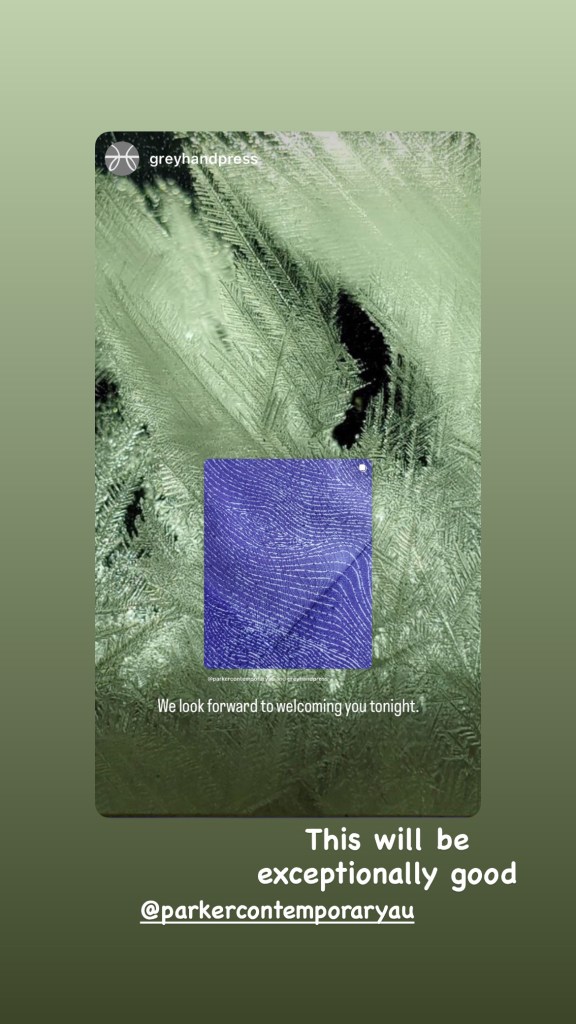
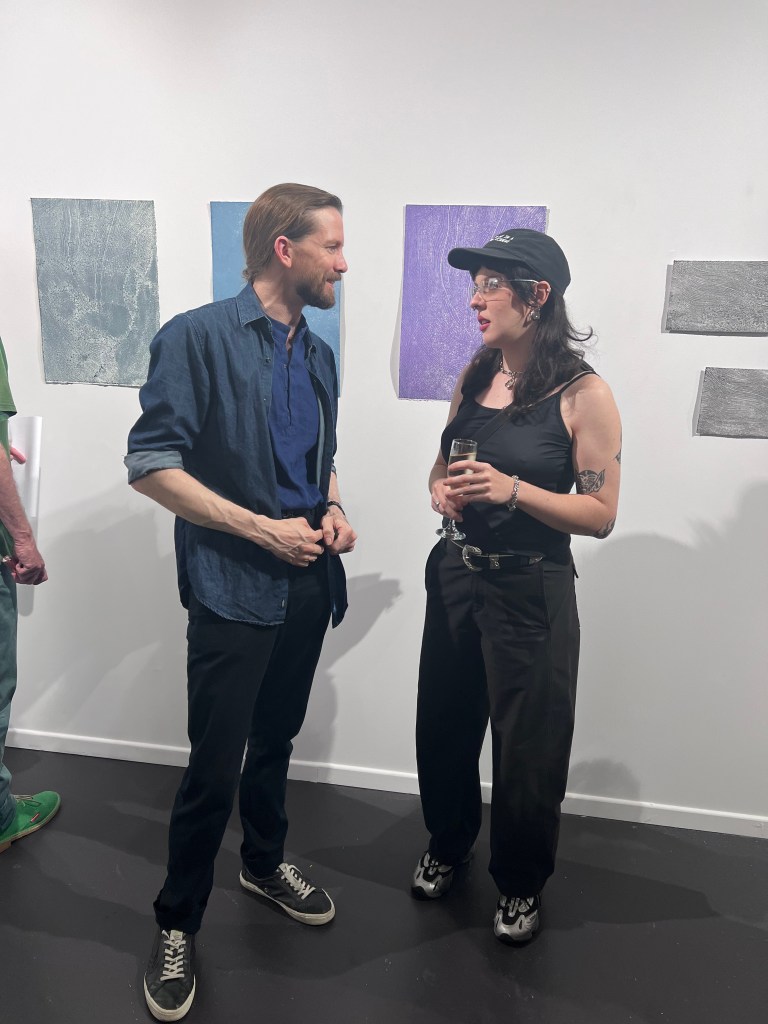
I was asked by Greyhand Press co-owner and artist Chris Hagen to present the opening speech at his first solo exhibition at Parkercontemporary of his work “Dissembling Assembly”. Below is the text of that speech,
HAPPY PRINTMAKERS: [ Instagram] “People who like printmaking are happier, smarter and better looking based on a study I just made up.”
As a 15 year old fresh from Melbourne I discovered body surfing on family holidays at Burleigh and Surfers Paradise. The wonder of the right and maybe the mythological 7th wave right into the sand or the dumper on a rough day. Looking out from the beach – line after line that eventually disappeared in the horizon or the beach. A mix of foam and chop, rising, falling. Drones and cameras capture those features now.
The predictability and unpredictability, of knowing and not knowing when to push off, when to roll back behind the rising wave, kicking and holding space and then sometimes taking a fizzier that took me a couple of metres or dumped me on the sand. And those of us who love the surf are mesmerised into going back in time and again.
This body of work “Dissembling Assembly” beyond meterological titles holds a mesmerising invitation. As the artist statement says: “Chris’s works hold structure and uncertainty at once. Some elements reveal themselves clearly whole others sit quietly asking for time and attention. The works unfold slowly rewarding careful looking and curiosity.”
This to me is reminiscent of John Berger’s “Ways of Seeing” where he says: “The relation between what we see and what we know is never settled. Each evening we see the sun set. We know that the earth is turning from it. Yet the knowledge, the explanation, never quite fits the sight.”
My favourite film director, Andrei Tarkovsky draws on the ocean metaphor here:
“If cinema is an ocean then the flow of images [Chris’s prints are the focus at this point] is waves on the ocean surface and far, far below in the deeper ocean currents is where the poet – Chris – is working. If the image moves, it is simply a consequence of the most superficial manifestation of developments in this hidden, inner world, the world of emotion and the spirit. When the unseen world flows through reality, when human behaviour is motivated by these ever-shifting currents of deep, wordless feeling, this is what we as audiences intuitively sense as time. Tarkovsky’s cinema/Chris Hagen’s prints are a mosaic made of time.
During my time with Jugglers Art Space and over the years 2012-2024 I curated White Silence events with artists, dancers and musicians responding in silence to each other, the space and music. I wanted to know and still want to know – what will the group and each person experience in such a mesmerising environment? Will a new knowing emerge out of their skills and collective mark making?
We come to knowledge according to our society’s education paraemters and policies via knowledge. We come to knowing however on the back of knowledge in a never ending cycle of wave upon wave of experience, epiphany, making, suffering, faith, non-faith and more.
These works are descriptive of that endless knowing cycle and a reponse to it.
J S Bach began to lose his sight towards the end of his life. An English eye surgeon – who it appears wasn’t a bona fide eye surgeon – operated on Bach only to make matters worse, plunging Bach into complete blindness. Back died soon after at 68. But there was a short moment when he, Bach, was able to see. in 1989, Australian composer, Graeme Koehne a piece in response to this “To his servant Bach, God grants a final glimpse, the morning star” – meaning symbollically – hope, divinity and new beginnings.
When we take time and focus in becoming “seers” we might not experience or see our god or divinity or even hope but we will hold more than aesthetics as our focus. As the late Irish poet, John O’Donohue wrote: “Beauty is more than glamour”.
Making sense of experience and life becomes an acceptance of trusted research, science and – mark making disciplines – and together the adaptive acceptance of experience, of living in the tenuous acceptance of paradox.
These works represent that so beautifully. They are a response to this paradox of “dissembling assembly” and are themselves “dissembling assembly.”
CONGRATULATIONS CHRIS!
 Peteskibreen's Blog