I recently had an invitation via Instagram from Berlin to submit 25 original drawings/prints/paintings [all A4 portrait orientation]for inclusion in the bi-ennial art magazine: Body and Soul BerlinArtist Magazine#45 Founded by Schoko Rosso 2005. They are to be submitted by August 2025 I will receive a copy of the magazine and one extra art work from one of the other 24 international contributors. My remaining original signed works will remain the property of the publisher who has taken over the project after the founder Schoko Rosso passed away. It seems like a good project. The project can be accessed on Facebook
I have been following an artist’s Instagram account in Germany – a native Ukrainian – who designs this magazine –Olesya Dzhurayeva. She is an outstanding print maker and recently had 3 of her lino-cuts purchased by the Victoria and Albert Museum in London.
If nothing else it shows that positve encouragement and motivation can be an outcome of the fraught and addictive social media phenonmenon. Olesya has regularly given feedback and positive support for my work on that platform.
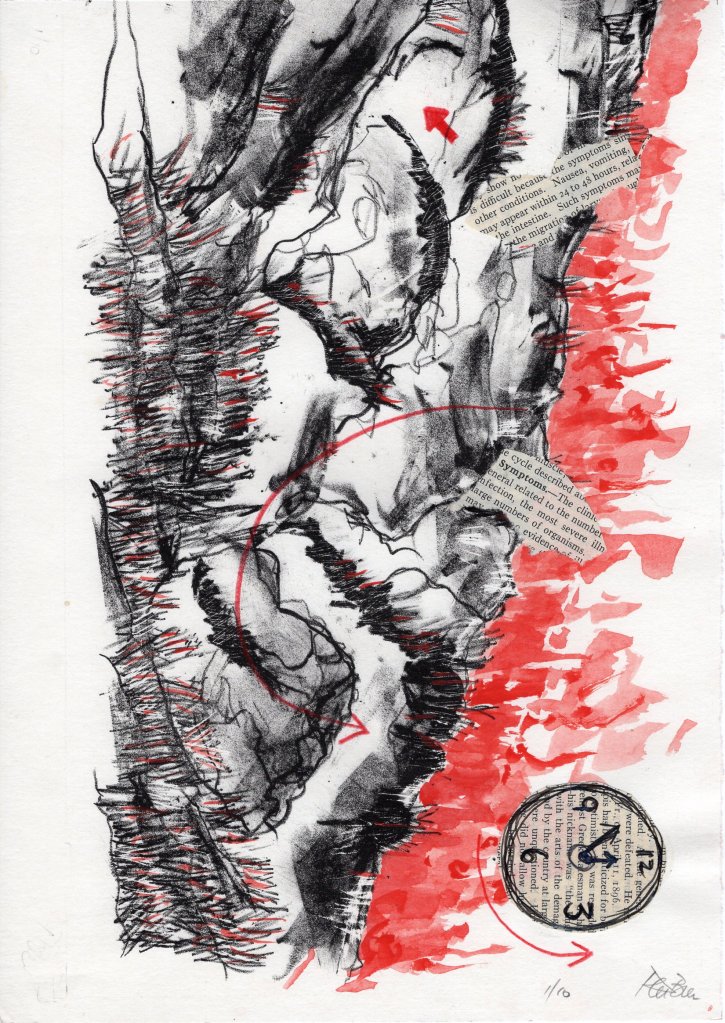
I have work begun using past plant monotypes and new collage work from my ritual acrostic ALSO. The circular thinking I am in moves from how to live well, rituals to assist life and the overwhelming events everywhere and particuarly Gaza, climate change and the recent election of Donald Trump.
These drafts below might make it in. Whatever the final work this is proving to be a time that I am thoroughly enjoying in the studio. I am very grateful to Olesya, publisher Hendrik and Instagram!
Media:
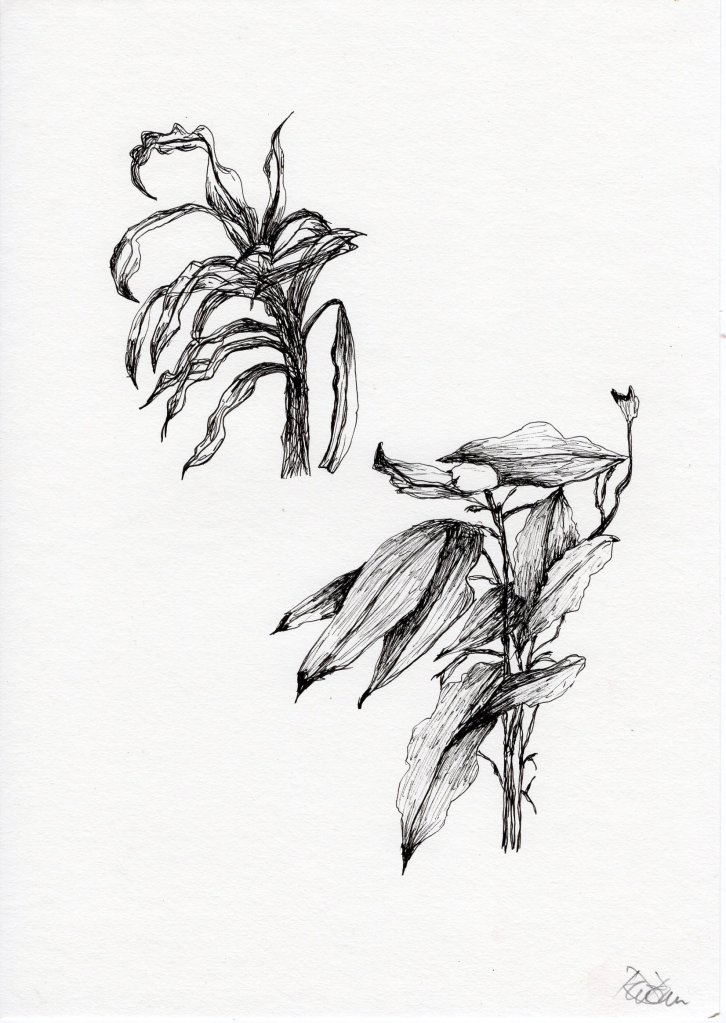
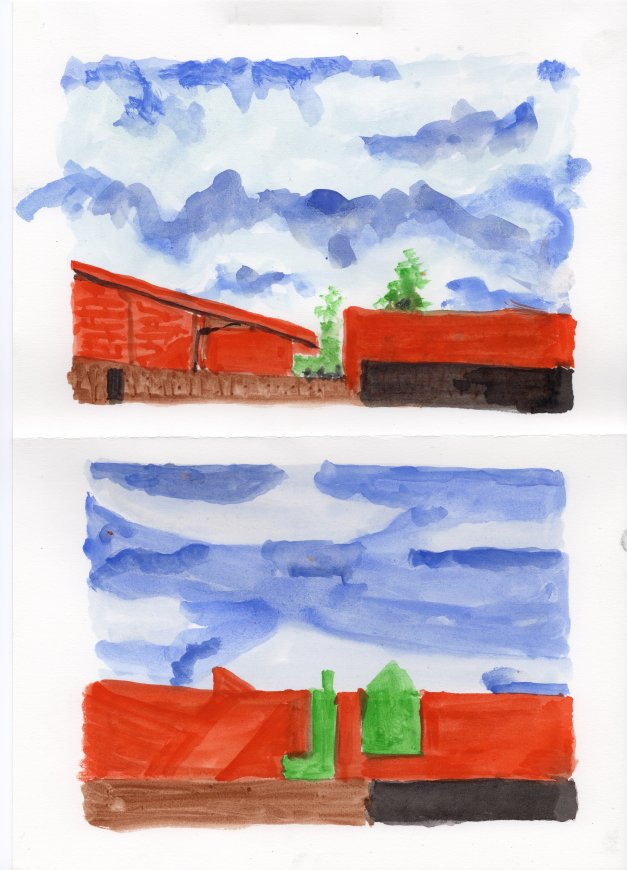
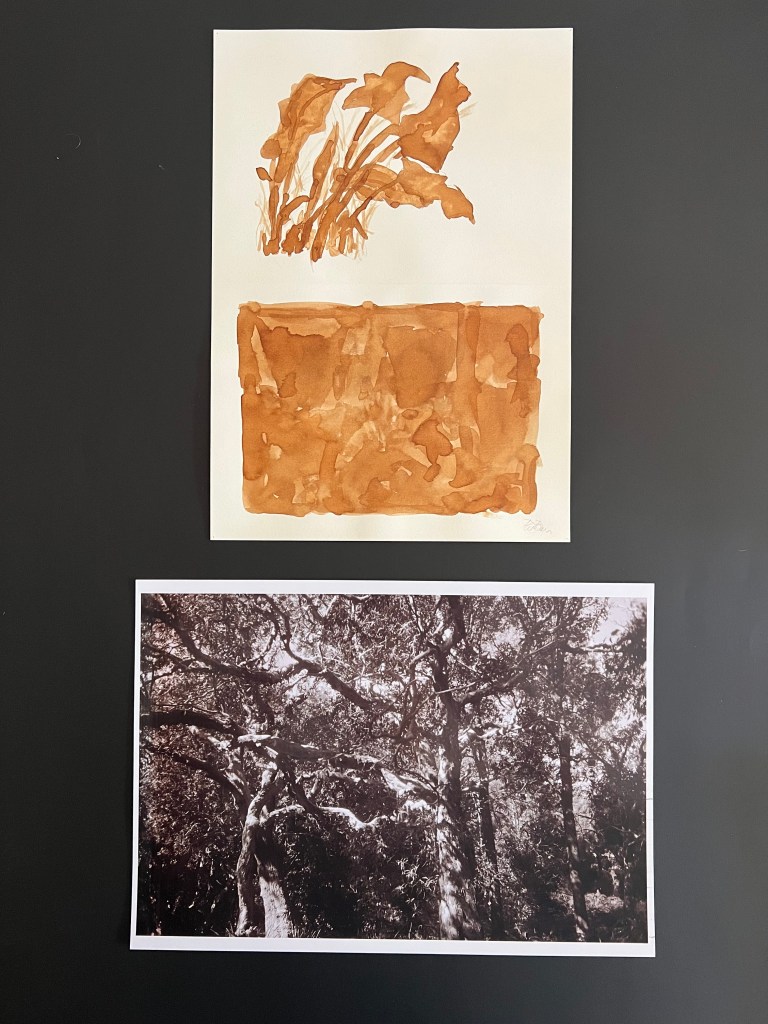
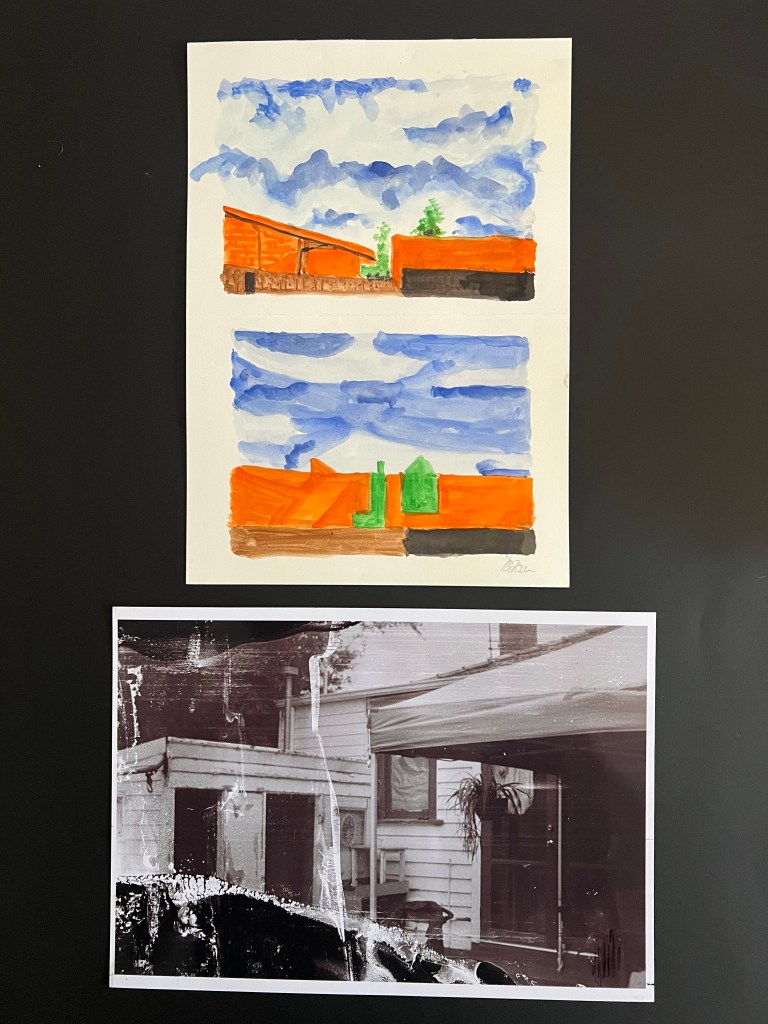
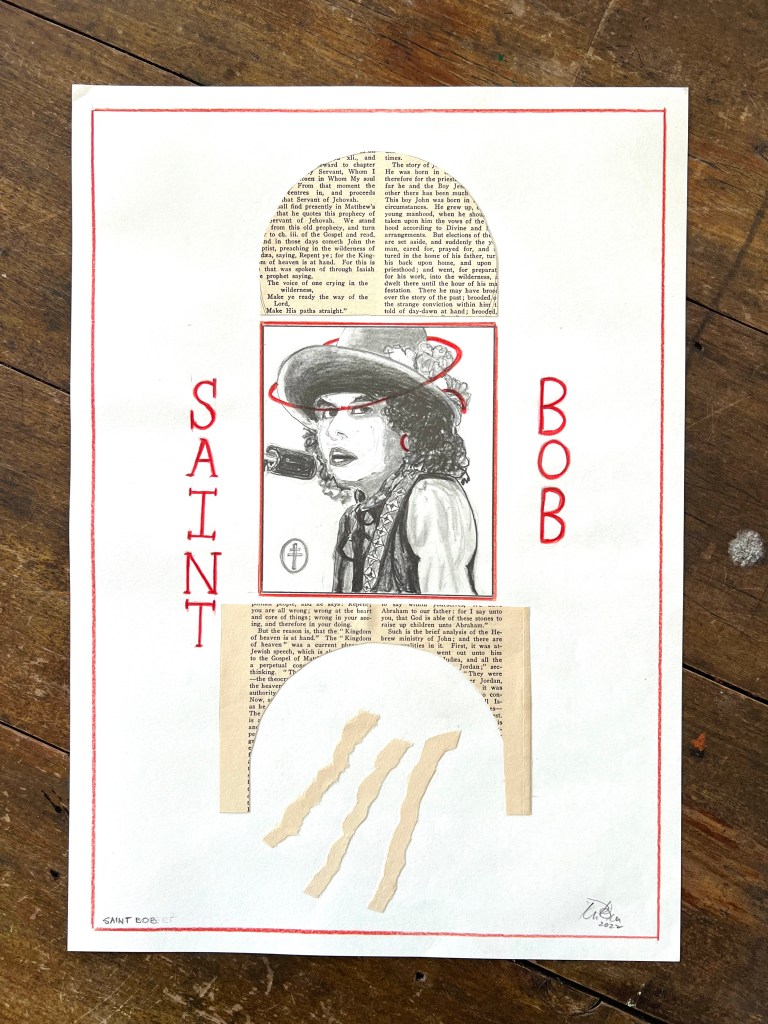
Plant monotype, collage and red guache, pen and ink sketch, guache/collage/red pencil on lithographic print. All on 160 gsm Paper [ Made in India]
There’s a story that was read to us as kids and then we read it to ours and now they read it to theirs and so the story goes on. It is, The Lion, The Witch and The Wardrobe – by Oxford don C S Lewis. It is a great christian based myth/allegory but it’s beautifully crafted and in the end the wicked witch is knocked out, the lion [ Aslan] dies and comes back to life and the wardrobe children are more than minions – they are princes and princesses and saints if you will.
Let’s fast forward from Narnia to Washington D C and the inauguration of President Trump today.
Feels like….?
Along with Trump and his billionaire minions are the prayers of Franklin Graham. Some of you will have no idea who that is but he is the cloned son of a once fauned and famous protestant evangelist – a salesman ostensibly – Rev Dr Billy Graham who was like the Protestant Pope in the heady days of Nixon and ML King.
After my swim this morning with Maeve [ necessary after her repaired broken hip and surgery – & doing really well!] I was showering and had this idea and as David Lynch says, when you have an idea WRITE IT DOWN!
Let’s play with C S Lewis.
The snow storm and a never been done before inauguration inside [ in a wardrobe??] where the magic light and the descent into the golden age of dark dawn reversals – cold hearted glee with which witch? The magic turkish delilght is a reject shop copy and the theories of a good world are elevated unapoligetically to replace love, social justice, grace and humilty by billionaires, a cloned evangelist [with a narrowly skewed literalist gospel ]and a narcissistic yellow lion look alike fake news saviour. The people cheer outside in the snow and we wonder who the saviour will be. The light just outside the wardrobe shines a yellow beam on snow and despair while in the wardrobe of doom the jingle of bit coins rings loud in the pockets of glazed eyed scrooges.
Lewis’s “resurrection” of the lion and the salvation assistants – the wardrobe children born of the light on the path – will be the people for “The people have the power” [ Patti Smith ]. The people slowly frozen down to almost down for the count will find the power in their collective born again vision for democracy, decency, humanity and justice born of necessity, born of despair, born of humanity while wisdom will arise in the stress of extremity. And it will be born again over time, times and half a time again and again while despots will die, money will rot and mother earth will roar.
I have never followed or been that interested in David Lynch. His prominence came about in my tightly controlled religious years – controlled by me and others – and so now as he has died and I discover his genius as a surrealist artist, I am playing catchup.
It seems that he was indeed a mystic, a surrealist and a genius. This is the current view by fans and critics both and I am strongly drawn to mysticism of all kinds.
I am partcilarly drawn to three statements of his I have listened to over the past week:
On death:
“I believe life is a continuum, and that no one really dies, they just drop their physical body and we’ll all meet again. Otherwise I don’t see how anybody could ever, once they see someone die, that they’d just disappear forever and that’s what we’re all bound to do. I’m sorry but it just doesn’t make any sense, it’s a continuum, and we’re all going to be fine at the end of the story.”
On ageing:
“Inside, we are ageless…and when we talk to ourselves, it’s the same age of the person we were talking to when we were little. It’s the body that is changing around the ageless centre.”
On music:
“Music can swell the heart till it almost bursts – you can’t believe that beauty that comes….and it comes from these notes…”
William Blake as an English outsider artist and poet [28 November 1757 – 12 August 1827] was dismissed by the church and the arts community as off the wall and crazy and then, as sometimes happens in history after the death of such a person, he became seen as a significant and highly influential poet and artist in the so called romantic school eg William Wordsworth. His mysticism had various iterations including a so-called visit from God at the window of his bedroom when he was a 4 year old and exposure to the Moravians and Count Zinzendorf. No doubt film and social media were big on the influence and popularity of David Lynch before his death and now he has joined Blake. I will be researching the primary influences on Lynch but surmise it will be at least, the father of surrealism, Salvatore Dali.
Artists are not always this influential and the seeking of influence is the curse [ and sometimes, maybe, small blessing] of social media. The artist who wants to paint and draw and direct films for the pure joy and struggle of mark making might become a Lynch or a Blake or most likely, not at all. They might at least and best have some sense of being in a place of purpose and meaning. This is becoming my experience now that I have some sense of condfidence in my own intentional mark making after hundreds of hours of making marks over the last 10-15 years. One needs to be determined and disciplined to be an artist and to write down any ideas that come as David Lynch used to say: Don’t rely on your own memory if you have a good idea – write it down however small or big it might be or become – a painting or a script for a film – write it down!
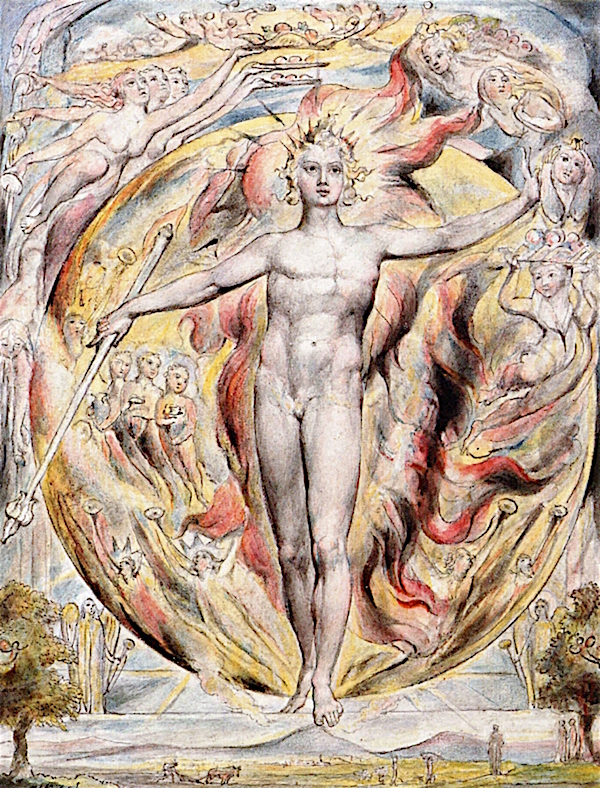
Blake’s apprenticeship as a young print maker developed his obvious draughtsmanship seen in such works below. [ The Sun at his Eastern Gate, Water colour over pen and ink, illustration, 1816-1820]
There is talent and then as “they” say, it’s all about perspiration. If one has some interest in and love for visual arts then get going and keep going – talented, young, old or disabled. It IS work, work, work, make, make, make that makes the artist and the place in his/her/their own story.
William Blake, 28 November 1757 – 12 August 1827
The Sun at his Eastern Gate, Water colour over pen and ink, illustration, 1816-1820
Blake and Lynch were huge talents, gifted and influential in their own and aligned worlds. They also tapped into another real but unseen mystical world, the imagination alive and the sense of the other as a regular visitor made alive in the making and in the final works we have to revisit.
Music as mind altering or God tapping on windows or strange groups of spiritualists doesn’t fit with rational thinking or scientific impiricism – albeit there is a huge upswing in qualitative research now – but it is a place where the spiritual is impinging on open hearts and minds. A breath, a silence or something akin.This is not a call to cultic exclusivism not a return to fundamentalism but rather is driven by my own intense interest, imagination and experience and one that I am convinced ties us all to the spirit/spiritual and to ancient and modern mythology, inexplicable inspiration, ideas and art beyond consumption and decoration.
Suggested Reading:
William Blake: Songs of Innocence and Experience,
Dr Martin Shaw Smokehole
Out of Office, Out of Mind Charcoal, guache on Arches Water Colour Paper 2024. Artist: Peter Breen
Peter Breen, January 2025. Brisbane Queensland Australia.
Imposter feelings represent a conflict between your self-perception and how others perceive you. You may fear or believe that you don’t deserve to be in a current position. The following strategies can help you resolve imposter feelings productively:
Acknowledge your feelings
Identifying imposter feelings can accomplish several goals:
Provide outside context
Talking with a trusted friend or mentor about your distress can provide objective information about your situation.
Reduce the fear of feeling overwhelmed
Defining and sharing imposter feelings can help them feel less overpowering.
Support yourself and others
Opening up to peers about how you feel can encourage them to do the same, helping you realize you aren’t the only one who may feel like an imposter.
Build connections
Avoid giving in to the urge to do everything yourself. Turn to coworkers to create a mutual support network. You can’t achieve everything alone. Your network can:offer guidance and support, validate your strengths,encourage your efforts to grow. Sharing imposter feelings can help others in the same position feel less alone. It creates the opportunity to share strategies for overcoming these feelings and related challenges you might encounter.
Challenge your doubts
When imposter feelings surface, ask yourself whether any facts support these beliefs. Then look for evidence to counter them. Say you’re considering applying for a promotion, but you don’t believe you have what it takes. Maybe a small mistake you made on a project a few months ago still haunts you. Or perhaps you think the coworkers who praise your work mostly feel sorry for you. Fooling all your coworkers would be difficult, and underperforming likely wouldn’t go unnoticed. If you consistently receive encouragement and recognition, that’s a good sign you’re doing plenty right — and deserve a chance for promotion.
Avoid comparing yourself to others
Comparing yourself to others is not beneficial. Everyone has unique abilities. Focusing on what makes you unique and exploring ways to further develop those abilities may stimulate healthy self-growth. You may not excel in every task you attempt, but you don’t have to. Even when it appears someone has everything under control, they may be facing difficulties you’re unaware of.
Imposter syndrome might feel like you’re somewhere you don’t belong. But success doesn’t require perfection. True perfection is practically impossible, so failing to achieve it doesn’t make you a fraud or imposter. Kindly and compassionately providing yourself with a more realistic perspective can counteract judgment and self-doubt and help encourage and support you in pursuing healthy self-growth.
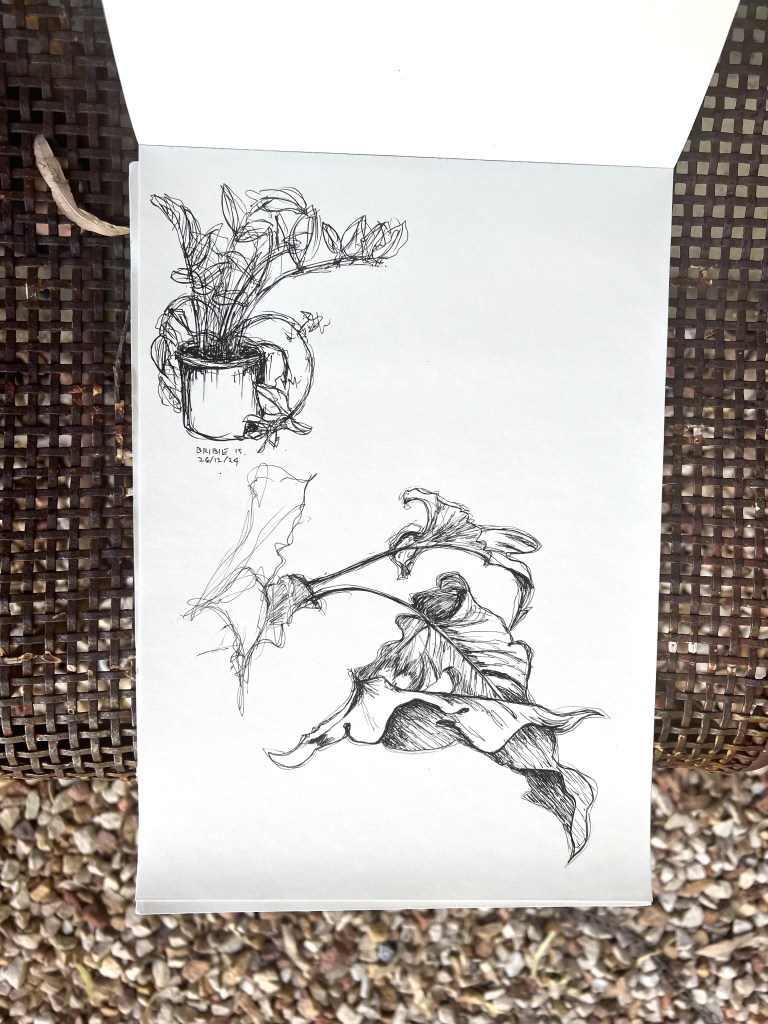
For a while now my first activity of the day after a few stretches and coffee is to draw. I make quick sketches of plants on the back deck and around the yard. Small sketches – usually 2 or 3 to an A4 page with a fine tipped Mitsubishi black pigment ink pen, or occassionally with an old Parker fountain pen. The paper is an inexpensive 160 gsm 24 page pad I found in Big W for $3. The paper is exceptional with a slight textured surface and an off white tint.
This new ritual has been going for about two or three months now but last week I had one of those mornings where two of the drawings on a page were not going well. The more line I added the less sexy they were! I brushed in some Indian ink which made both drawings look like graffiti tags and not the kind of sketch I wanted – as per the above. I developed this daily ritual for eye hand coordation and to keep learning to draw! It’s also become a meditation for the day’s beginnings.
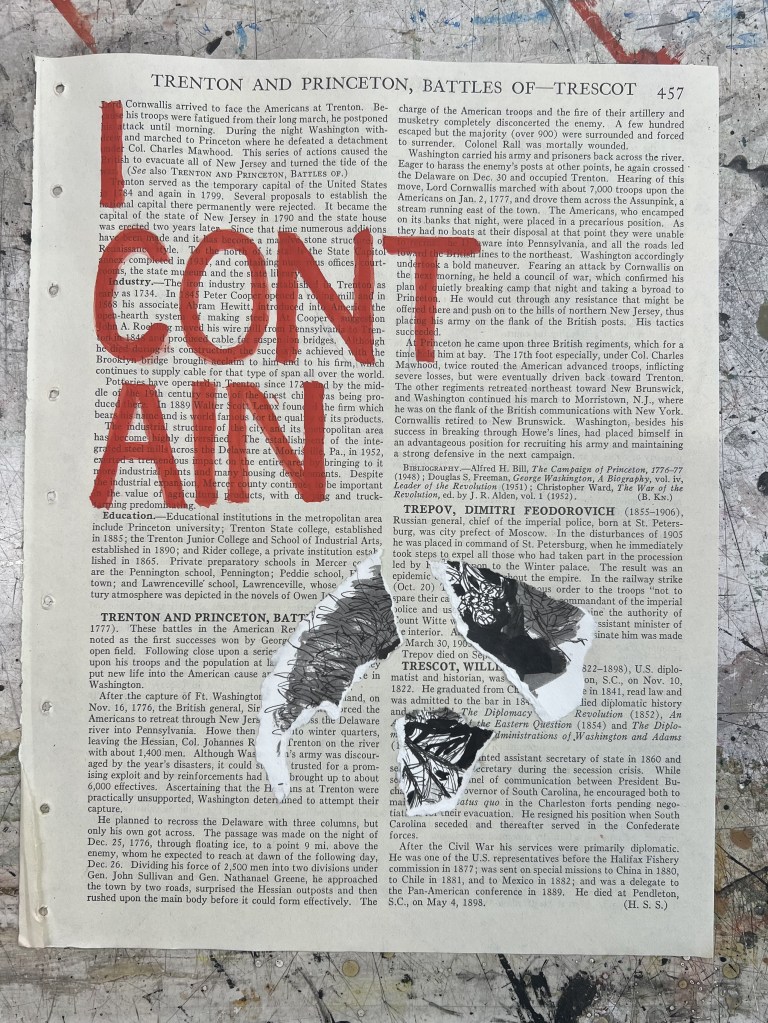
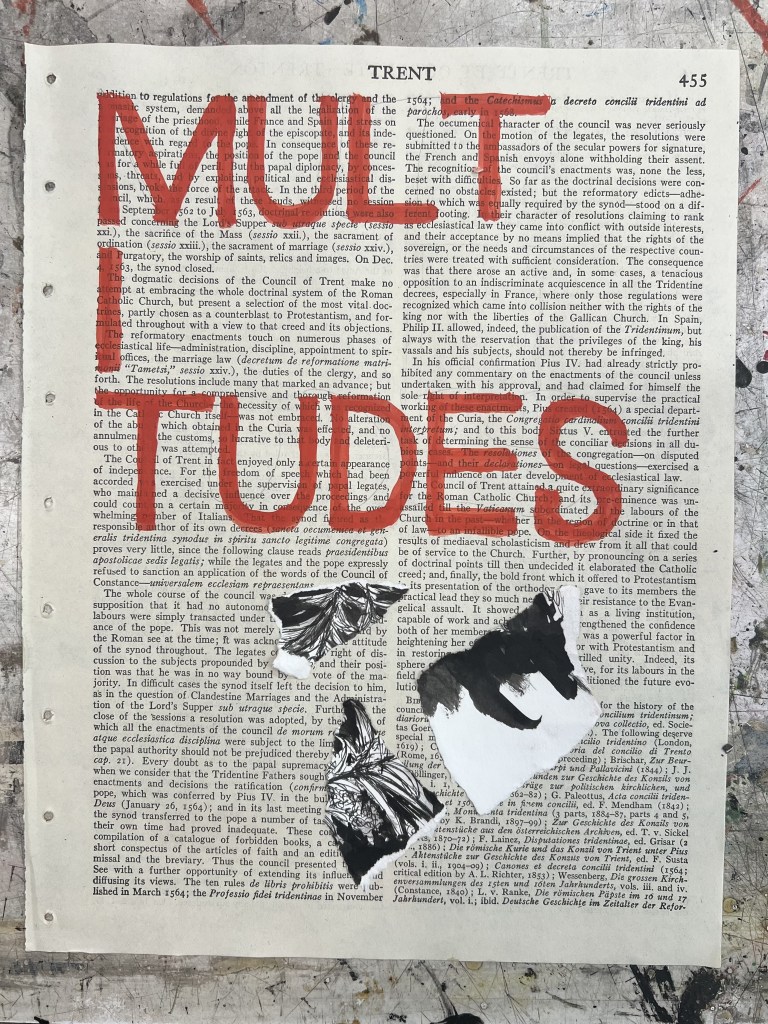
I tore out the two failures and threw the torn page segment in the bin. There was one satisfactory sketch on a third of a page with a ripped edge. After an hour or two I began to reflect on the idea of drawing/art as story where the story is attached to the process – including the frustration, the tearing and the binning with a ripped page remaining and in the drawing itself. The affect and story building of the drawing on the viewer, including the aesthetic appeal or otherwise, is part of the mystery of art for viewers, gallerists, collectors, critics and artists.
Then a new story began to form for me around the binned drawings. I pulled them out and began tearing up the page around and through the failed drawings. I began arranging these bits on found printed encyclopedia pages [ Encyclopedia Britannica] and finally I drew the opening words of a recent Bob Dylan song on two pages: I contain multitudes. The bits of discard became random collage pieces glued to the old print pages telling a story about me , my drawing that morning and the recreation of something new.
I am interested in what kind of story or experience this might trigger for others who read this “art as story” of mine.
It’s important to keep making marks if for no other reason it makes us into better artists so that we can make marks that are good! But it is also important to reflect on the failures and to let an emerging idea out of the failures grab us, find a story evolving around that emerging idea and make work in those moments that leads us to rework bad work – or sometimes to discard it altogether. We will know how to find the path in those moments. This example from my daily ritual is not about a commission or the preparation of a body of work for a group show. It was part of my daily drawing ritual and so this meant I was under no pressure or high expectations that often sits with me when I am preparing for an exhbition or a group show. Because I was able to take more time and did take a more inutive reflective approach to what might be done with the discard, I found I was able to follow a small idea about reworking the “bad art” by listening with intution into working up something entirely different that I am happy with. Inspiration comes and “doors open” when we least expect them to but we must be working and failing and succeeding and being still all in a flow that has us in its gentle grip.
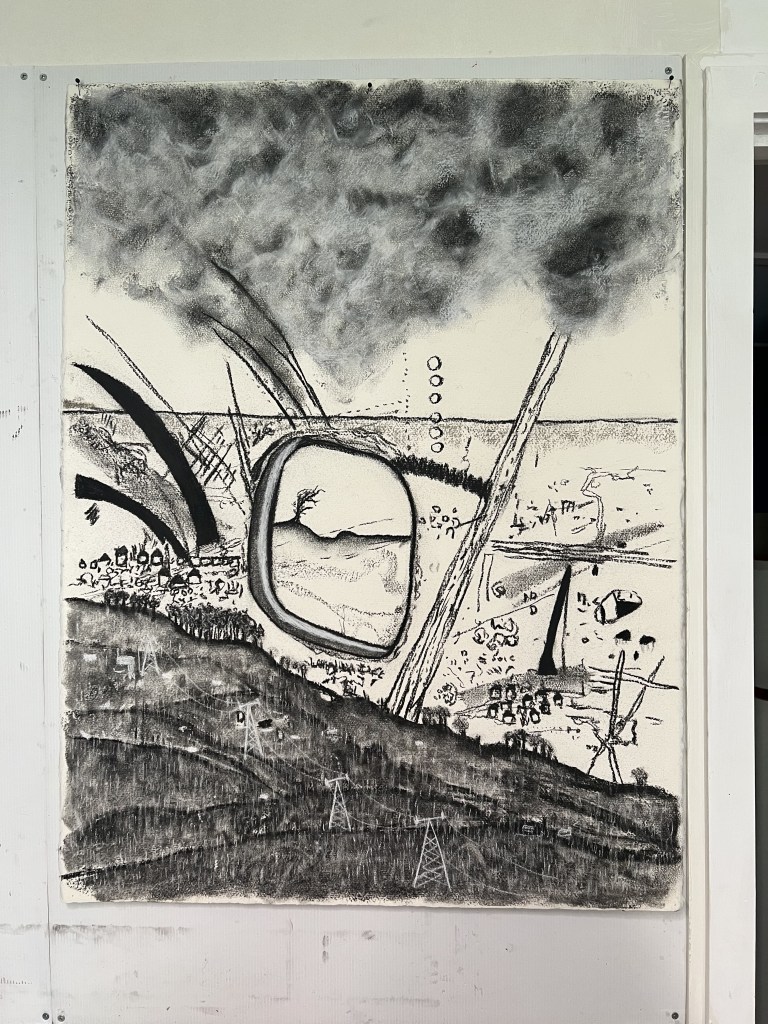
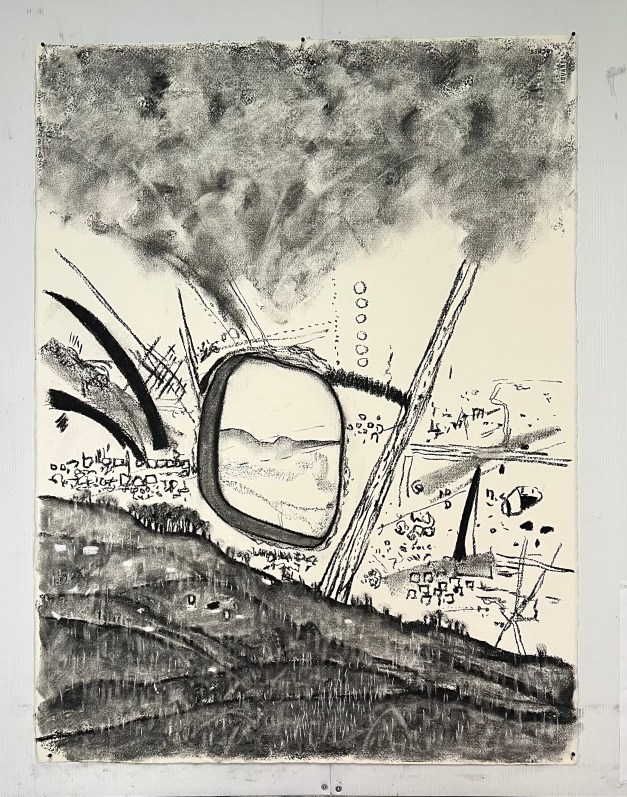
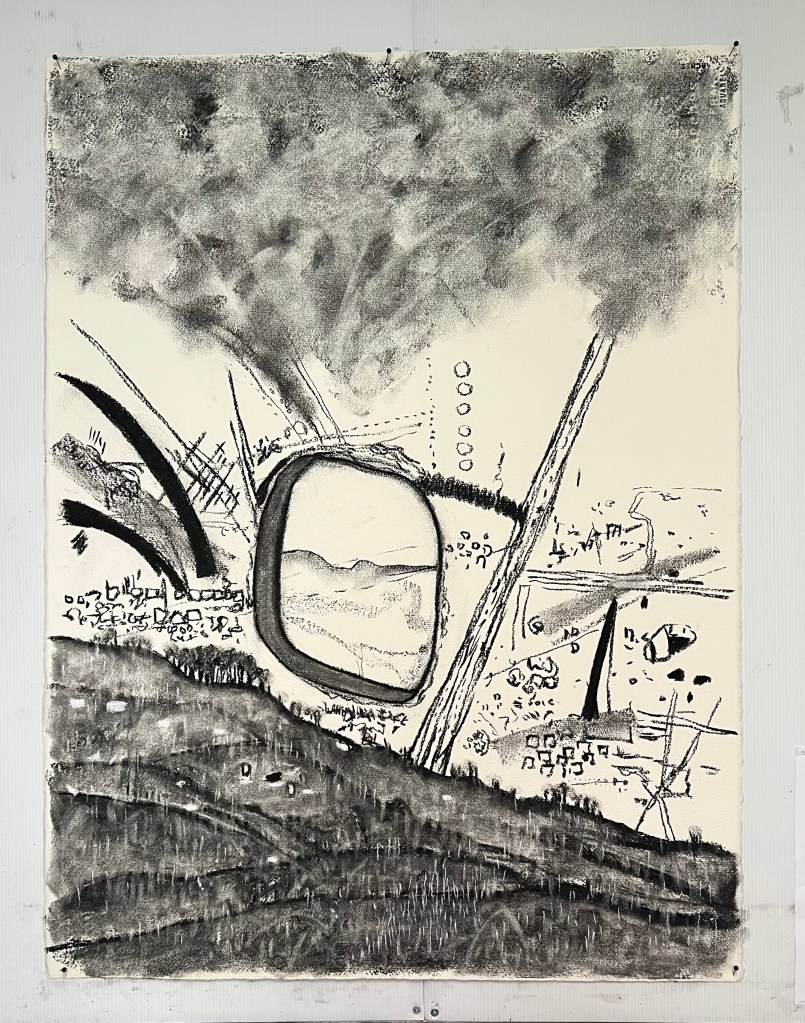
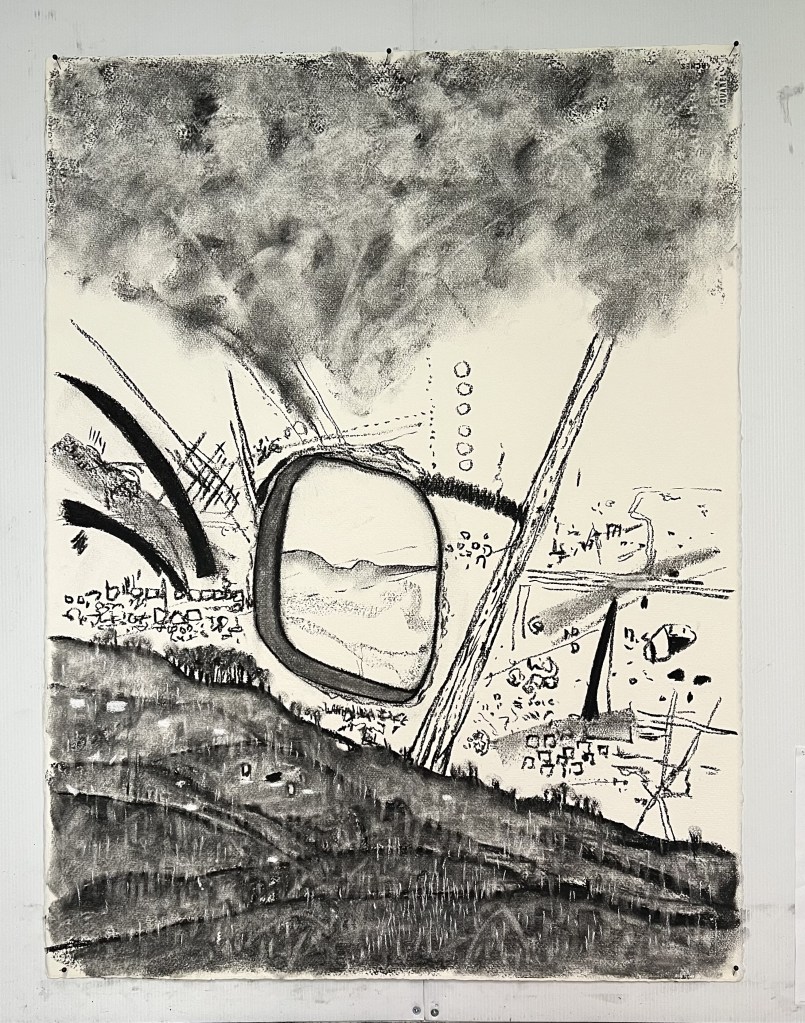
This is a work in progress [WIP] but probably done now. I prepared this is a hurry after hearing Stuart Greenbaum’s composition “City Lights – One Mile Up” on ABC Classic FM and my response was a memory of flying into Narm. It seems that my drawing habit is to leave the work as if finished and then return to finish it off – sometimes weeks later which is the case here. I added the horizon line which divided the drawing into 3. I back filled the black charcol random shapes and shaded the sky after adding white charcoal, added a sole tree in the window and high volage towers in white charcoal. This now works better than its earlier face. [ Charcoal on Arches paper]
When you’re feeling stressed and take a step back and consider a larger macro perspective and practice gratitude and happiness for what you have now. Below are ten steps to resetting your mindset:
1. Fix the Comparison Culture Trap Comparison is insidious. It destroys creativity, clarity and growth (and happiness). So, let’s nip it in the bud. The only person you should compare yourself to is yourself, in the past. The only question that matters is this: am I growing and am I improving? If not, that’s the perfect place to start for reclaiming a wandering mind, or a feeling of being stuck. If you need to, get off social media – or change who you follow and what you see. There’s a lot of toxic, unhealthy content out there, so choose things that are inspiring and helpful. Eventually, with the right mindset you can start to shift comparison to healthier inspiration.
2. Refocus On Skill Building + Education Skill building and education always give me new perspectives, motivation and ideas. You can feel, in real time, that I’m bettering myself and working towards some higher goal or purpose. A great way to reset yourself is to learn a new skill or improve on an existing one — because even experts have more to learn. Bonus points if you can attach that skill to some personal goal or your values and vision.
3. Use A Growth Mindset Our mindsets will influence our health, wellness, happiness and confidence. Literally, everything we want to do and achieve traces back to our mindset. This is a fascinating field that essentially proves our brains are able to adapt, change and learn new things – like, anything. This throws a wrench in the whole fixed mindset idea that we’re either “born with it” or not and this reality of being able to grow our skills includes being able to change our perspectives on things. At the end of the day, it’s just way more fun, inspiring and motivating to come from a place of growth potential (vs. thinking you have no control or ability to improve). So doing a hard reset with a growth mindset is pure synergy.
4. Exercise Break A simple way to reset our minds and energy to start implementing an exercise routine – whatever that may look like. You don’t need to stress about pushing yourself to some extreme either, even light exercise has benefits and leads to a healthier, more sustainable habit formation.
5. Step Away Stepping away is a classic move. It can help us refresh and reset our perspectives on things. We can step away by taking a short twenty minute break or going for a walk, or we can get away, by taking a vacation day or even traveling. These things can seriously help reset our life. A simple solution to not losing our minds is simply scheduling in more breaks.
6. Remember Your Values This is a big one – knowing and remembering my core values and if you’re not entirely sure what they are, it’s actually kind of fun to find out. You know those personality-type tests we all love? If you’re doing a reset, having some values in place can be great way to build up after the refresh.
7. Know Your Why Having a driving purpose, reason and goal that’s attached to the things you’re doing can provide a lot of motivation and inspiration. Once you have isolated some larger, long-term goals, a good strategy is to break them down into smaller bite-sized goals and tasks to complete.
8. Reorganize My Schedule: Do More of What I Want It’s often forgotten or not taken seriously. So reorganising and reprioritising your schedule is a helpful strategy for a successful reset. After all, we don’t want to just end up in the same situation that got us to needing a reset in the first place. Schedule more time for you. Find a new hobby if you need to, otherwise find a way to make more time for yourself and your passions.(Re)prioritise thingsOrganise your day differentlyDelegate tasks or outsource tasksMake a schedule for you time, and stick to it
9. Status Check: Is the Deck in Our Favor? We’re surrounded by all sorts of outside influences, people and ideas. And they’re not always conducive for our goals, clarity and mindset. Take stock of the things in your life and adjust them to better support you. Here are 3 key areas I feel are most important:Your inner circle (who you spend your time with)Your outer circle (the content you consume daily and download subconsciously)Your environment (your home, room and spaces – the smell, design, sounds, etc.)
10. Laugh More + Don’t Take Yourself Too Seriously We can sometimes put too much pressure on ourselves, our work and life in general. Refocusing things to a more casual place can do wonders for our sanity. Laughing more and not reacting to everything with quick emotional responses is like a secret wisdom weapon.
Image: Water Colour on paper. #untitled Artist: Peter Breen
British Mythologist Dr Martin Shaw tells stories, makes up stories, revises stories, translates myths and talks about them. Incessantly. I find his spoken word and books a new discipline revealing a new path of spiritual and cultural forest exploration. And it is as if I am in a hall or under a tree listening intently. Recently I watched a short video of controversial New York composer Philip Glass talking about what is required for the arts. For visual art it is looking and for music performance it is listening. Overstating the obvious but nevertheless it was a refocus reminder. My world, in and out of family, is around and outside and inside music and visual art. I have had a switch turned on in my head recently that has taken me beyond the aesthetic appeal of art as I struggle and wonder what on earth art making is for and about. My looking has changed to see that the works in our house, on walls and in draws, on desks half finished and pinned on boards as stories in process, chapters, phrases, moments. And so too are those at GOMA, NGV, QCA and MONA and on trains and subway walls. Stories and myths that invite us to look and then to listen as if it was a performance giving voice to the still small voice of the artist finding and telling her/his/their story in a mysterious darkness that we interpret and wonder at in an “ah-ha” moment – eventually – or in a dissonant disiplined looking and wondering that leaves us maybe judging the aesthetic or modality rather than wondering about the artist and the story.
The following are some visual stories of mine from about 2020.
What stories are hidden in these?
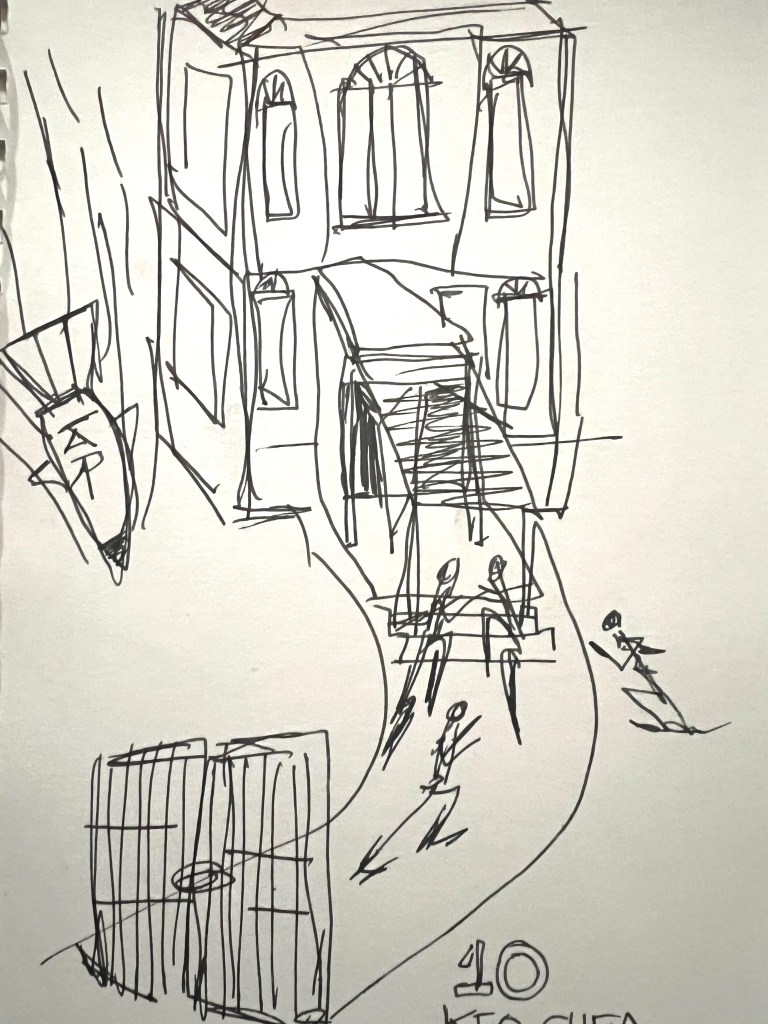
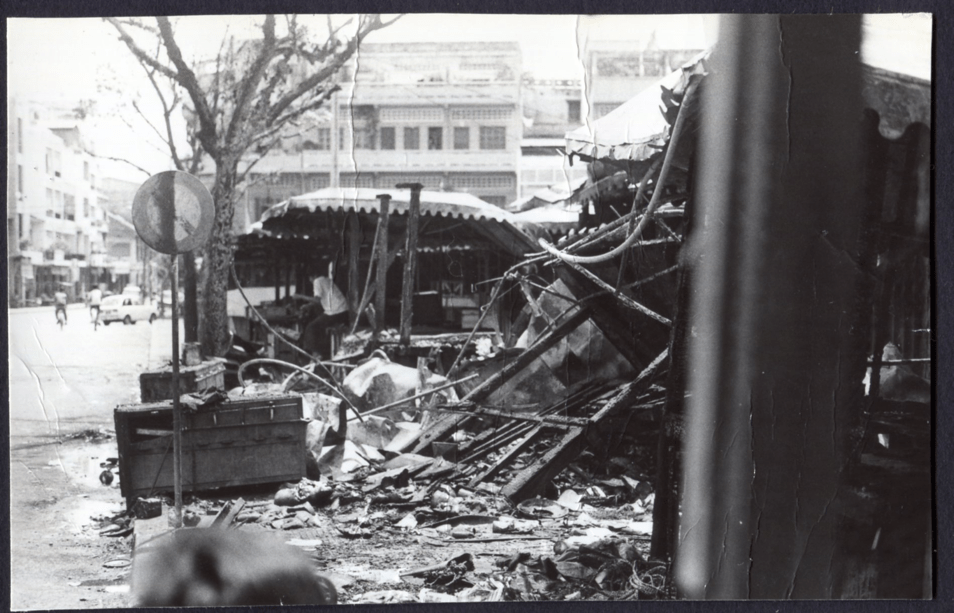
These – below – are quick drawings responding to some of my experiences in Cambodia in 1974/75 at the height of the Vietnam war with its Cambodian and Pol Pot Killing fields knocking at the door.
City Lights – A Mile Up Charcoal on Arches Paper Artist: Peter Breen
Out of Office, Out of Mind Charcoal, guache, collage on Fabriano Paper. Artist: Peter Breen
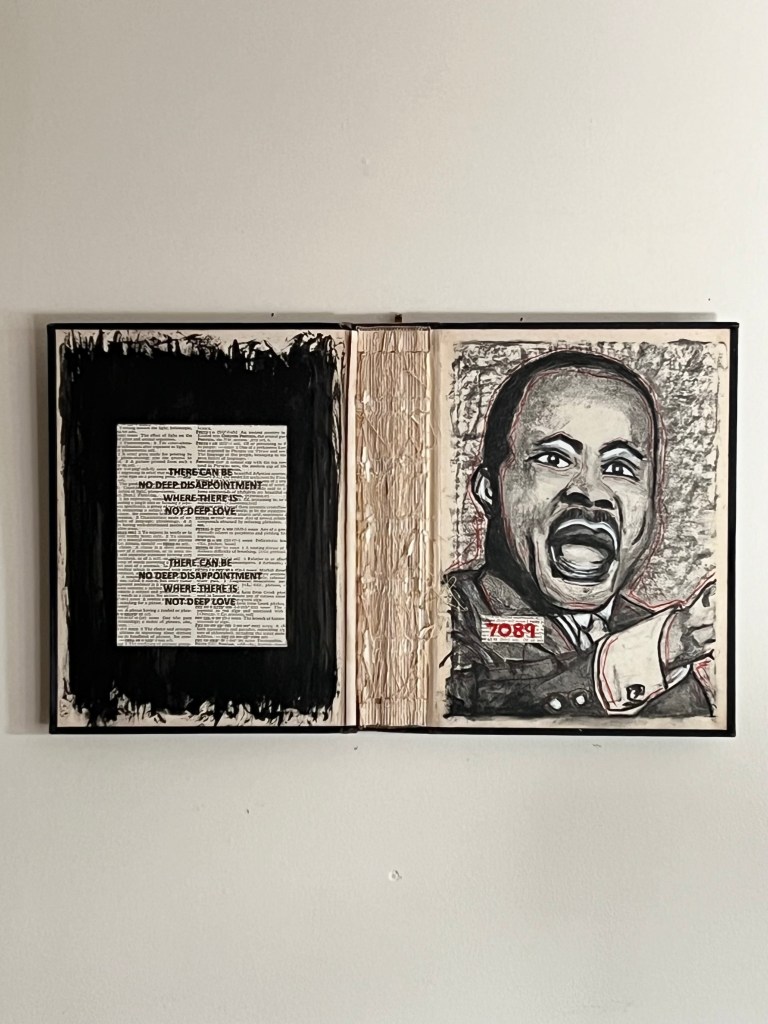
He being dead, still speaks Ink, collage, charcoal, guache, pencil, glue [liquid nails], found book cover. Artist: Peter Breen
These works have all been completed this year – 2024.
The Martin Luther King Jr mixed media drawing is on the book cover remains of a 1950’s Funk and Wagnells Dictionary. I have used all the pages over the past few years in this book to draw and print on. Mixed media included black and white ink, charcoal, red pencil, and gouache. This is a work for the invitation only Vacant Assembly Block Show in December 2024 where artists are asked to prepare a work in the general dimensions of a besser block. The book cover has been secured by using liquid nails to adhere two strips of wood on the back with options for hooks to hang it with. I’m interested in the use of old books, old book pages and old book covers through the work of William Kentridge and Sam Lock [ a British minimalist abstract painter].
The office worker drawing is for an invitation only group show at Flying Colours bar in West End. The theme: “Out of Office”. The idea of desperation of the masses who grind away on the treadmills of living in a capitalist society at breakneck – and break the spirit – pace to fund the growth myth leads to starved souls, vacant eyes and a longing for the flowers of beauty and renewal. “Out of Office, Out of Mind” I posted a work in process as well as the finished work in the back end of the studio.
The first charcoal drawing:
“City Lights – A Mile Up“
“This work was drawn in response to Australian composer Stuart Greenbaum’s work “City Lights – A Mile Up.” I drew this in my home studio with the paper pinned to the wall. When I heard Greenbaum’s music i imagined flying into Melbourne [Naarm] my birth place. I sketched the first idea in my journal with fountain pen. Flying into Melbourne is always a joy with rolling hills on the approach, mostly dark skies and at night, lights and roads scattering and moving, heaving and dropping away. This work is about that anticipation and the inherent beauty of lights and industrial constructed impacts on once pristine space, landscape and country. My regular ritual is to draw daily, with pencil, ink or fountain pen in my studio or back deck and I have a print making practice relief print [ lino – cut] and monotype.
What is a work of art
if not to be a squeeze of something inert untouchd
and unable to be assessed by smart logic
a kind of smart not felt but deduced outside of intuition and affect
while small marks and loud, colours and movement of charcoal
splashed with bent brushes finding not a design but a final resting place
In 2012 when the former LNP Leader Campbell Newman came to power as premier [for one term] he came with the same kind of mantra as this guy. It is classic Machiavellian rhetoric that convinces the general public. You’re being robbed – we will fix it and lock ‘ em up. Then under Newman and Bleiji – it was graffiti writers and bikies. On the first Saturday after Newman came to power Jugglers private property was invaded by two plain clothes QPS officers when they saw two young artists painting in the tunnel. On private property! And parking their vehicle over the driveway on the footpath and having been enboldened by the new Premier they marched in waving their new found popwer. What ensued was a frigtening experience for the lads ending up with my going to the Crime and Misconduct Commission about the incident. Now under this government it is [largely] young aborigial kids. At the time Newman came to power, I was running Jugglers Art Space and had been working with a New York model Diversion program experiment in the Brisbane Magistrate’s Court [ Court #1] with magistrate Christine Roney with some contact with Sisters Inside Inc ‘s Debbie Kilroy . It was set up to assist with a new way – diversion instead of incarceration – of dealing with law and order issues in a way that would both help the arrested person to find new pathways, reduce recidivism and reduce the impact of imprisonment on the state – among other things. We were working with that court with young people arrested for graffiti misdemeanors as were the The Salvation Army Australia and other groups around other social misdemeanours. Within the first month of the new Newman Government the new Attorney General – Jarrod Bleiji – yes the same Deputy [who would be premier] Premier sworn in today dumped the Masistrate Court #1 Program. “I don’t believe in diversion programs and they don’t work” he was quoted as saying. We need and must push back against this draconion cruel and just plain dumb approach to law and order. I am not advocating for riots and law breaking without consequence. I am advocating for intelligent, compasionate and long term belief in humanity, family systems and better approaches to the crime among young people. The current new idea – it isn’t! – by this new government will fail and will not make us a better or safer state around this issue. Just a more fearful one.
Peter Breen, Co-Founder, Jugglers Art Space Inc
Queensland LNP’s ‘fresh start’ for youth detention is just a cruel repackaging of failed punitive policies
‘Beneath all of the fancy footwork and buzzwords, it’s just another punitive approach that punishes children for the failures of the state.’
The Queensland Liberal-National Party’s so-called “fresh start” for Queensland’s youth detention system is anything but fresh. Over the weekend the LNP released its detention reform program as part of its “Making our Community Safer Plan”, citing their “Detention with Purpose” program as a fresh start for Queensland. However, what we really got was a rehash of the tired, punitive measures of the past dressed up as rehabilitation — where words like “discipline” and “purpose” were being trotted out to mask the root causes of so-called youth crime and the very nature of rehabilitation.
The plan claims to reform youth detention by focusing on discipline and rehabilitation through compulsory education, behavioural management programs, and a zero-tolerance approach to violence. Under this proposal, privileges like TV and social time would be earned through good behaviour, while violent behaviour would result in enforced periods of isolation (solitary confinement). The plan aims to reduce “recidivism” by imposing consequences for both good and bad behaviour, alongside a 12-month post-detention support program to supposedly help kids reintegrate. But beneath all of the fancy footwork and buzzwords, it’s just another punitive approach that punishes children for the failures of the state.
Put aside the fact that we do not have the kind of “youth crime crisis” that LNP Leader David Crisafulli would have you believe. This was aptly debunked by criminologists this month, who offered data demonstrating a dramatic decline in youth crime rates in every state across Australia. Children are being used in this election as electoral fodder to win votes, and Crisafulli is so desperate to be elected that he seems prepared to throw our kids into hard cells to get the top job.LNP is set for an easy win in Queensland, but its first term may pose a much greater challengeRead More
The reality is, children’s prisons have become the default response to all of society’s problems — poverty, lack of housing, inadequate access to education, and the absence of proper healthcare. In blaming children for these failures, the LNP has created a policy that is not only unjust but will also be cruel and ineffective.
Let’s be clear: youth detention centres are not and will never be places of rehabilitation. They are children’s prisons. They are designed to punish, isolate, and control children, many of whom have already suffered at the hands of the state through racist policies of child removals, over-policing, surveillance and systemic neglect. And yet, the LNP wants to sell the voting public on the idea that locking a child away in a prison will somehow “rehabilitate” them — as if the state, as the commanding force in the child’s life, can be the correcting agent to “turn the child’s life around”. For many of those children, the state has been a violent and racist abuser.
This is a plan built on a false premise: that children in prison are there because they need discipline and consequences for bad behaviour. The LNP conveniently sidesteps the state’s role in producing the conditions that lead to criminalisation in the first place. Compulsory education, framed as a solution in this plan, feels more like a band-aid for a gaping wound.
If the LNP truly valued education for our children, why would they rip kids out of classrooms to lock them in cages? Why not pack support around our kids to keep them in the community? How can we expect kids to engage meaningfully with education while the trauma, instability, and abuse they’ve experienced goes unaddressed? Schools often fail these children long before they are imprisoned. Once they’re inside, the LNP offers no plan for individualised support, no resources for trauma-informed care, and no pathway to genuine healing.
Education inside a prison is not a solution; it’s the state’s admission of failure. If education were truly a priority, we would not need prisons to deliver it. Forcing children to learn while isolated from their families and communities, under the psychological pressure of confinement, is nothing short of cruel.
Moreover, we must acknowledge that many of these children are victims themselves — of abuse, neglect, systemic racism, and social deprivation. Imprisoning these children is a grotesque act of victimising them all over again. It is the state’s attempt to erase its own culpability by shifting the blame onto the very children it has failed.In the 50 years since I was locked up as a kid, nothing has really changed in AustraliaRead More
The LNP’s plan to use solitary confinement — a form of isolation known to cause severe psychological damage and considered by the UN as a form of torture — is presented as a way to “reform” these young lives. But the reality is punitive measures like solitary confinement and behavioural management programs do nothing to reduce reoffending. These practices, in fact, make things worse by compounding the trauma that led many of these children into conflict with the law in the first place.
Instead of rehashing punitive measures, the LNP should be focusing on social policies that build up our communities. We need more resources for public housing, education, mental health services, and opportunities for children to heal and grow in their communities, homes, and classrooms — not in prisons. Growth and development cannot happen behind bars. It happens in safe, nurturing environments where children are supported, not blamed and punished for circumstances beyond their control.
The LNP’s “fresh start” is a fundamental failure right from the beginning. Its so-called plan to reduce the criminalisation of our children will only increase the harm done to some of the most vulnerable in our communities. Under this policy, the real victims will be our children — criminalised, punished, and abandoned by a party more interested in slogans and soundbites than in genuine solutions.
The state must be held accountable for the well-being of every child, especially those in its care. It’s time to stop pretending that prisons are the answer. Children deserve better. They deserve real care and support, not just a new name for the same old punishment.
Debbie Kilroy OAM was first criminalised at the age of 13 and spent more than two decades in and out of women’s and children’s prisons. Driven to end the criminalisation and imprisonment of girls and women, Debbie established Sisters Inside, as well as her law firm, Kilroy & Callaghan Lawyers.
Tabitha Lean is an abolition activist, writer and story teller who organises to disrupt and dismantle the colonial project, abolish the prison industrial complex, and annihilate racial capitalism.
Empathy is crucial for connection, healing and compassion and is about understanding and sharing the feelings of others rather than offering quick fixes or dismissing emotions. By setting aside judgment, truly listening to others, and connecting with their emotions without trying to fix or minimize their pain, you can build meaningful, empathetic connections. Empathy is a skill that can be cultivated through practice, and it’s one of the most powerful ways to foster genuine relationships and support others through difficult times. Below are steps that can help us build empathy and strengthen our connections with others:
1. Perspective-Taking See the world from another person’s viewpoint: Empathy starts with trying to understand how the other person is seeing and experiencing a situation. This means setting aside your own judgments and truly imagining what it feels like to be in their shoes.Avoid judgment: Brown emphasizes that empathy involves non-judgment. When someone shares something vulnerable, it’s easy to judge or dismiss their feelings, but empathy requires you to simply listen and accept their perspective, even if it’s different from your own. 2. Stay Out of Judgment Avoid “shoulds” and advice-giving: Rather than trying to fix the situation or offer solutions, empathy requires resisting the urge to judge the other person’s emotions or circumstances. Sentiments like “you should feel grateful” or “you shouldn’t feel that way” block empathy.Be open and curious: Instead of assuming you know what someone should or shouldn’t feel, practice curiosity. Ask questions or simply listen without preconceived notions about what is “right” or “wrong” to feel. 3. Recognize Emotion in Others Tune into emotions, not just words: Empathy involves recognizing the emotional undertones of someone’s experience. This means being aware of body language, tone of voice, and underlying emotions, even if they’re not explicitly stated.Validate their feelings: Even if you haven’t had the same experience, you can validate emotions by acknowledging them. Phrases like “That sounds really tough,” or “I can see how you’d feel that way,” let the other person know you’re connecting with their emotions. 4. Communicate Your Understanding Reflect back what you hear: To show empathy, let the person know you understand their feelings. You might say, “It sounds like you’re really hurt by what happened,” or “I can hear how overwhelming this is for you.”Avoid dismissing or minimizing: Empathy isn’t about saying “It’s not that bad” or “Everything will be fine.” Even if your intentions are good, these statements can make the other person feel unheard. Instead, acknowledge their pain without trying to lessen it. 5. Connect with Your Own Vulnerability Access your own emotions: Brown emphasizes that empathy requires being in touch with your own vulnerability. If you can connect with your own feelings of fear, sadness, or frustration, you’re better equipped to relate to what someone else is experiencing.Share in the emotion: Rather than feeling sorry for someone (which is sympathy), empathy is about sharing in the feeling. It means letting yourself feel discomfort with them and acknowledging that their pain is valid. 6. Be Present Show up fully: One of the most important elements of empathy is being fully present with the other person. This means setting aside distractions and focusing completely on the conversation. Empathy doesn’t require you to have all the answers—just to show up and listen.Sit with discomfort: Sometimes, empathy involves sitting with someone’s pain without trying to fix it. It can be uncomfortable to witness another person’s suffering, but true empathy requires being there for them, even when it’s hard. 7. Mind Your Responses Don’t downplay or “silver line” the pain: Brown often speaks about how empathy is hindered when people try to offer silver linings. For example, saying, “Well, at least you still have your health” can make someone feel like their pain is dismissed. Instead, acknowledge the difficulty of what they’re going through without offering quick fixes.Avoid “at least” statements: Empathy means listening without comparison. Phrases like “At least…” minimize the other person’s feelings. Instead, try to stay with the emotion being expressed, without trying to shift the focus elsewhere. 8. Empathy in Action Practice emotional attunement: Building empathy is not just about words, but about actions and body language that show you’re fully attuned to the other person’s emotions. Nodding, maintaining eye contact, and showing concern with your posture can all help convey empathy.Offer support that matches their needs: Once you’ve listened and connected with the other person’s emotions, offer support that aligns with what they need. Sometimes they may want advice, but often they just need someone to listen or sit with them in their discomfort.
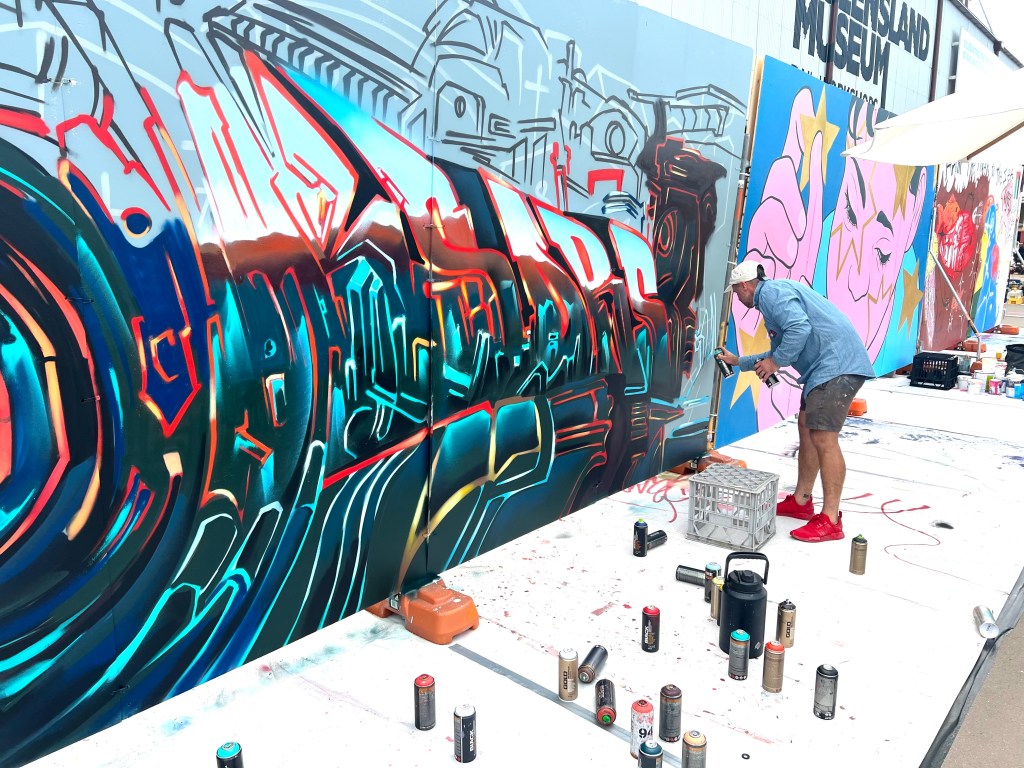
Tracks of History: Railroads, Train Art, and Cultural Narratives
One of the things I have learnt over the past 27 years since Jugglers started in Brisbane is that the evolution of art and mark making is a phenomenon with a life of its own. There is a constant in the human imagination, an endless movement in minds, souls and the visceral subconsious that creates a hunger for mark making, a hunger that needs to be asuaged and that is so once marks are made, however naive and undeveloped.
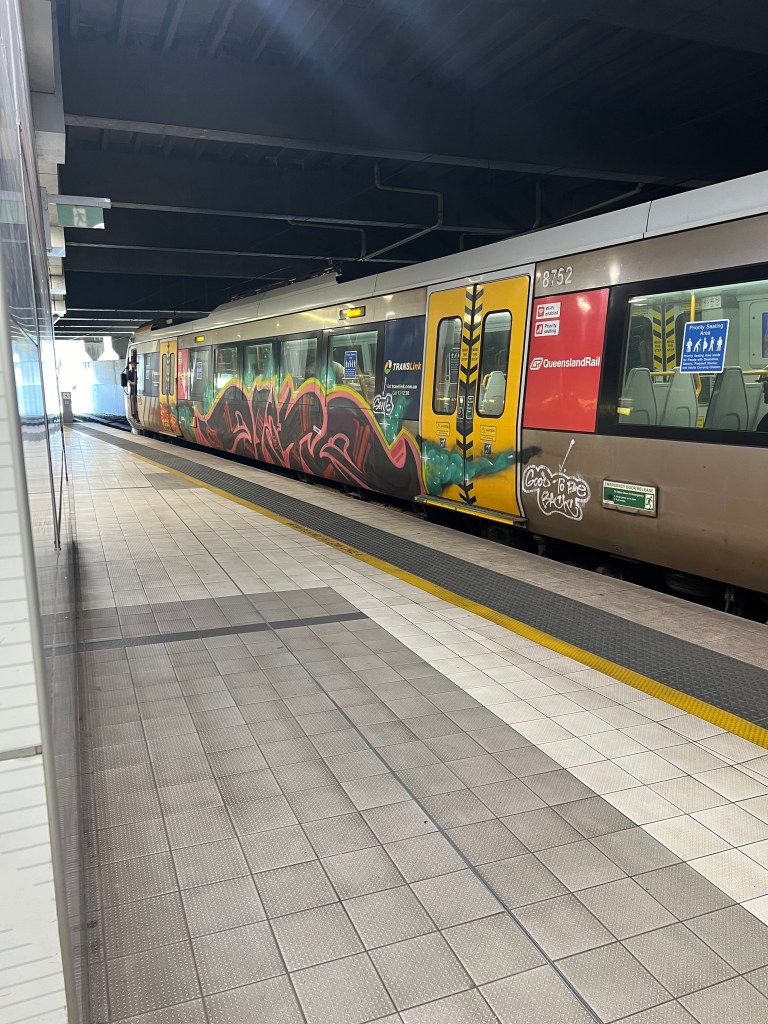
People have said to me: ” I love the mural kind of art but not the tags on fences and trains.” My usual reply is: “How do you think the process unfolds to where you enjoy the aesthetics of pubic murals?” A child’s early marks are restricted into something she must unlearn over a lifetime.
That a train museum would hold a street art event on site in Queensland was another indicator of the evolution of this life. An embracing of the unstoppable life of art and artists. Someone has said “Graffiti is the last bastion of freedom of speech” and yet this bastion will never be silenced. Street art in Queensland is alive and well and so too are tags and throw ups on QR trains. I have seen more train graffiti in Brisbane in the last couple of years than I had in the previous 20 – except after the 2011 Brisbane floods when trains were unguarded and accessible away from the Bowen Hills train yards.
There are tidal waves of crack downs and graffiti activity on trains and buildings in Queensland over the years that is indicative of the hunger for mark making and control of its aesthetic and application. Murals and street art are not replacing graffiti and one could say that there is an attempt at the gentrification of the art of graffiti. Mark making has for centuries had graffiti interations with names and tags while graffiti and tagging with aerosol was a new public art phenonmenon kicked off in New York on trains the 1960’s. It has been famously captured in the 1983 film Style Wars and by photographer Martha Cooper in her bible of graffiti Subway Art . A film by Brisbane film maker and Jugglers friend, Selina Miles – Martha tells some of the story. A TAG Conference was initiated in 2017 in Europe to consider the history and current practice of tags and graffiti. https://www.tag2024.org/
Campbell Newman the 2012-2014 Queensland Premier came to power on the back of a few slogans with one very clear one being his mantra to eliminate graffiti and graffiti mark makers from Queensland. His attempt included bullying and intimidation but clearly this has not worked. The argument around cost to the public is understandable while graffiti as the bastion of freedom of speech is as much about politics as art. It won’t go away soon and my view is that it may well emerge as something hungered for as social media infects the synapses of this generation.
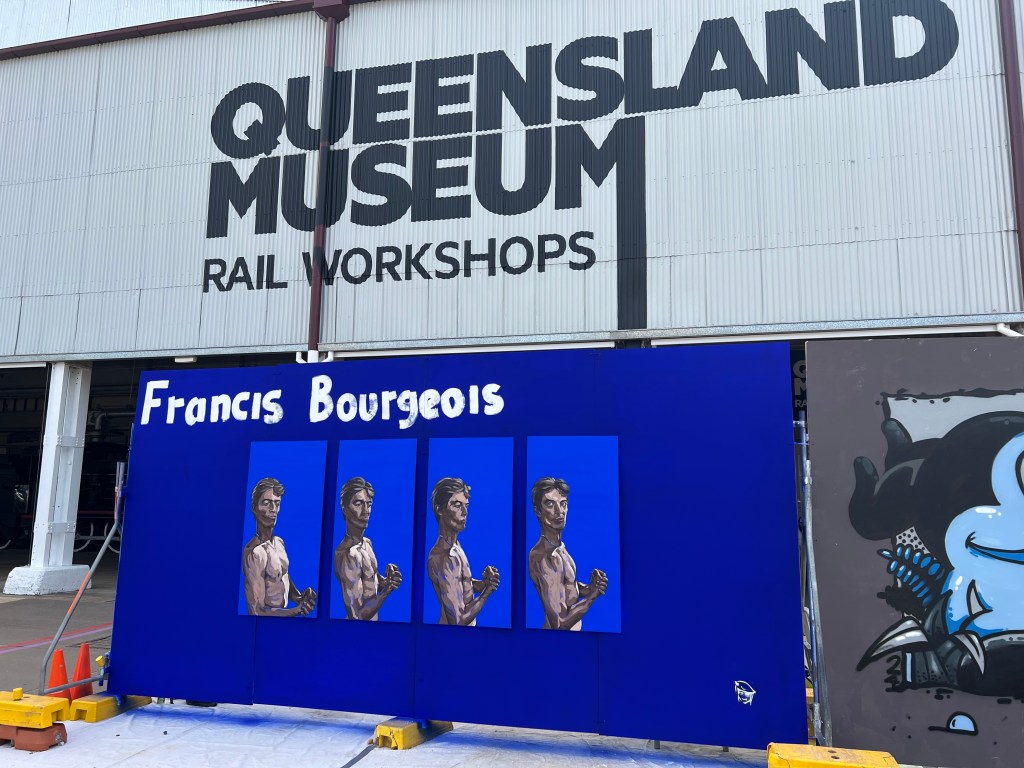
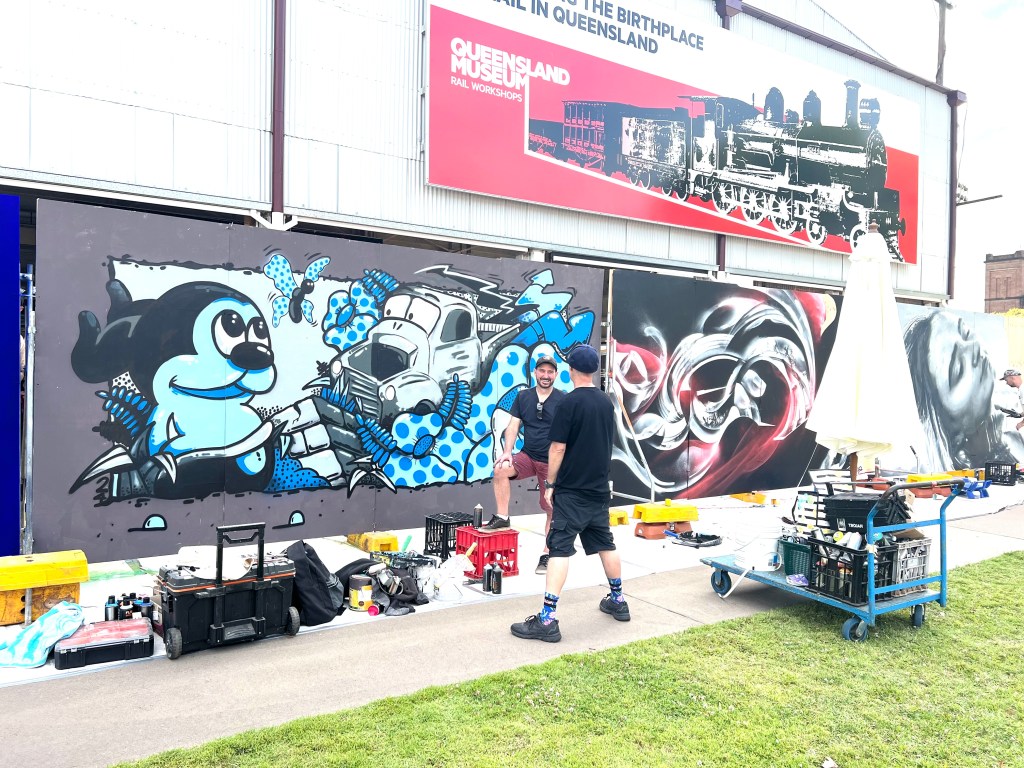
Train art at Brunswick Street Station, Fortitude Valley, Brisbane. September 2024
I was asked to facilatate a panel of 5 artists who were painting at the close of this all day event around the theme: Tracks of History:Railroads, Rail Art and Cultural Narratives. The artists were public street art muralists with a range of experiences in street art and graffiti. The conversation did touch on the illegal experimentation but mostly it focussed on the evolution of street art that now postively includes aboriginal and female artists that was once in Australia a young white male only collective.
Despite the heat of the day – it was Ipswich after all – there was a strong sense of good times and the plan for it to be repeated in 2025. The event was initiated by the Museum of Brisbane and curated by Yonder Festival and Super Ordinary in Brisbane. All artists and panel participants were paid – as was the facilitator and even though it was not an hourly rate it did cover some basic costs for travel and some paint. Boards and all preparation were supplied by the museum.
“The misconception which has haunted philosophic literature throughout the centuries is the notion of ‘independent existence.’ There is no such mode of existence; every entity is to be understood in terms of the way it is interwoven with the rest of the universe.”
– Alfred North Whitehead
“I searched for Buddha – the wise one who sees and knows the true nature of reality, the one who understands the cause and solution of suffering, the one who walks in peace, serenity, and liberation. I searched for Buddha but I could not find him. I only found this enlightenment inside myself.
I searched for Guanyin – the mother of universal and indiscriminate compassion, the one with motherly resolve to liberate all her children from suffering. I searched for Guanyin but could not find her. I only found this boundless compassion inside myself.
I searched for Jesus – the one who unifies his divinity and humanity, the one who transcends the dualism of God and man, the one who knows no separation between heaven and earth. I searched for Jesus but could not find him. I only found this great completion inside myself.
I searched for Socrates – the one who questions, the one who investigate all things curiously, deeply, critically and introspectively, the one who ordered his life according to virtue and love. I searched for Socrates but I could not find him. I only found this wisdom inside myself.
I searched for Dr. King – the one who would not claim freedom for himself as long as his fellow human beings languished in isolation, suffering and oppression, the one who fearlessly championed the cause of the victimized, marginalized, maltreated, and forgotten. I searched for Dr. King but I could not find him. I only found this calling inside myself.
I searched for a God – the fundamental nature of reality, the ultimate ground of all being, the primordial essence of all that is, the wholeness and completeness at the heart of all things. I searched for a God out there somewhere but I could not find him. I only found this ultimate reality as the nature of all things and the essence of what I am.”
Jim Palmer
From Jim Palmer – Facebook Page – Founder for Non-Religious Spirituality
The personal is personal! And sometimes there’s a memory lapse as I go on and write or talk or draw as it always comes back to making sense of living, and now, impending death – I’m well at the moment and have no life threatening diseases – and God/god! And the church/religion! I spent 52 years flat out in it and now at 74 I have been flat out out of it for 22 years!
I read a book by a conservative activist in the 1970’s Oz Guiness “Doubt – Faith in two minds” and it helped me put doubts on the back burner and ostensibly come back to them. They, doubts, are all I have at times and yet the closed systems I hung onto needed and have been pushed away, abandoned and questioned. This is my journey and in finding Jim Palmer on Facebook was an interesting discovery. Strong dominant male leaders have sucked me in over the years and so I am a bit wary. But there is a pattern of his kind around. My own thoughts, readings, children and various authentic social media accounts post my exit from the church/religion continue to lead me to similar positions as Palmer [cited above].
Two excellent books from a pile of excellent books – and one that quotes Alfred Lord Whitehead – is by American theologian Catherine Keller – On the Mystery – Discerning Divinity in Process. The other is Courting the Wild Twin by the wonderful mythologist Dr Martin Shaw. Keller’s style is very demanding to read with a style that I need to re-read to get the gist of. But I get what she is driving at and it’s good to read a woman theologian’s work! Shame on me. Here are strong words from my favourite chapter – Sticky Justice: “Agapic or compassionate love has seemed sentimental, inffectual, patronizing. It prefers charity to structural change. In response we can only insist : those who are oppressed don’t want our compassion, they just want justice. They want a shift in the stucture of power that block their possibilities, that shut down their life process. ” P114
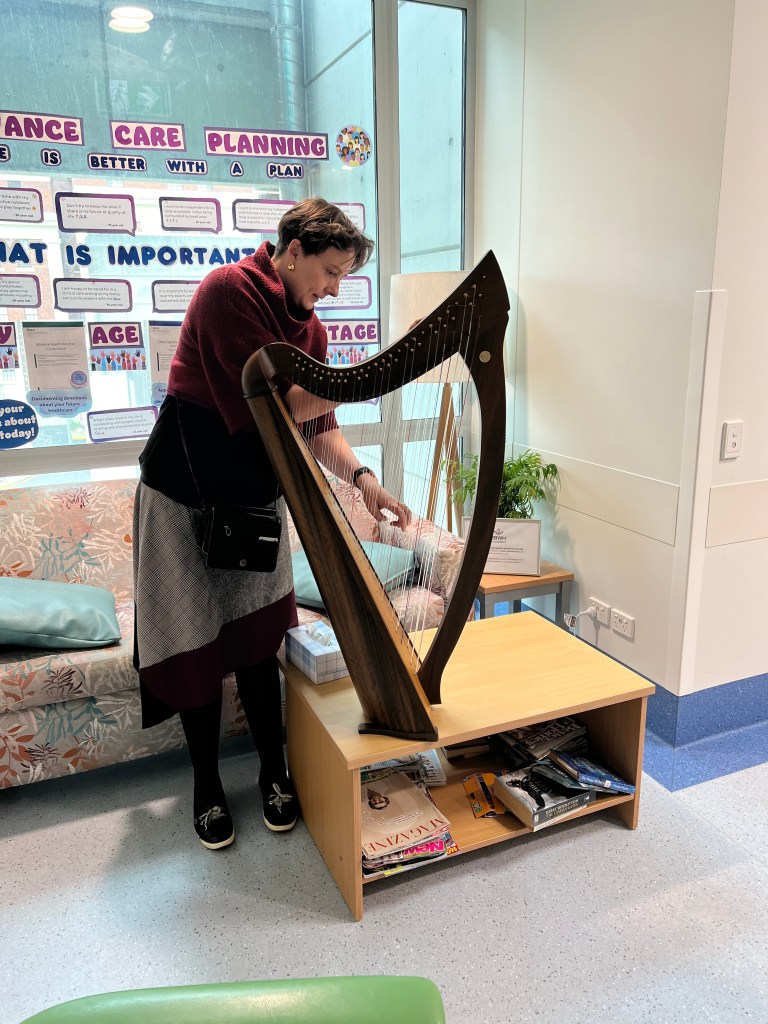
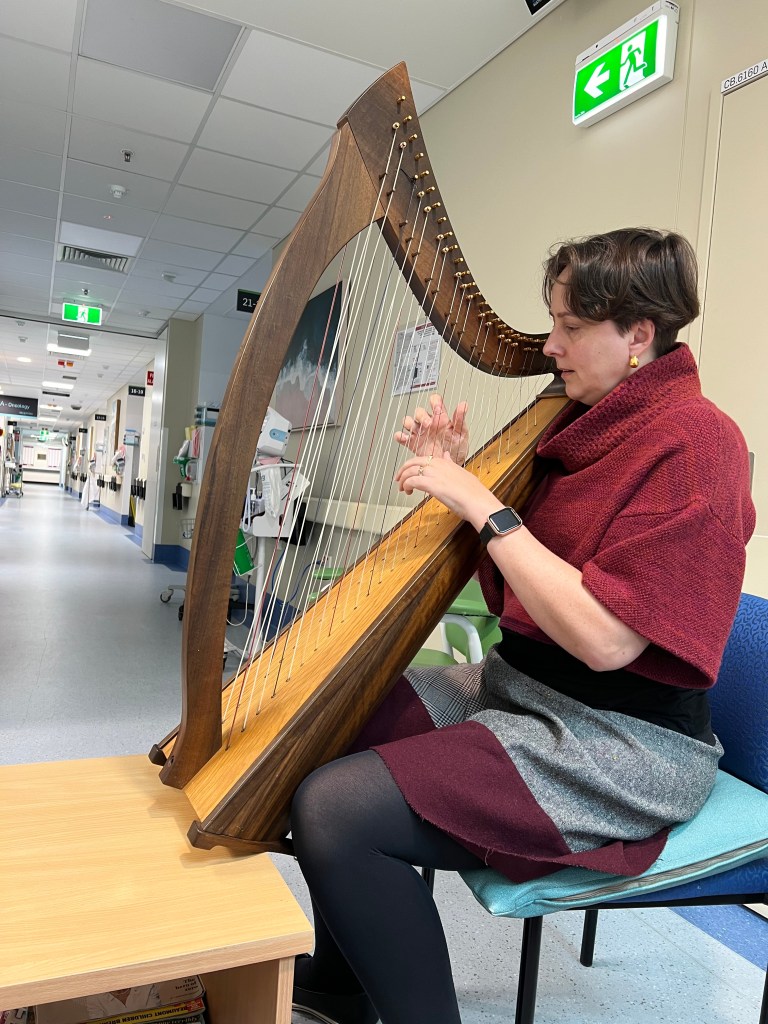
Nicole Tate – Stairwell Project Harpist, Cancer Ward, RBWH, June 2024
As you know The Stairwell Project and You Can Make Some Noise Workshops are two small live music initiatives we started at the Royal Brisbane and Womens’ Hospital – The Stairwell Project in 2015 and the YCMSN Workshops in 2022. It seems we are, with both of them, “punching above our weight” in respect of the the calming and other positive affects on patients, staff and musicians.
I had a phone call last week from Nicole Tate who plays harp in one of the general cancer wards at the RBWH each Saturday, being unavailable during the week. In school holidays however she plays there on weekdays. Patients are coming and going a lot more with clinics open and consultants in the wards. Last week during the school holidays she was in the ward midweek. There was no crisis or roster problem – it was that she wanted to share a bit of that day’s experience with me – a spontaneus group singing with her as she played , the smiles on people’s faces, the positivity from staff. I gathered from her report that that day was a high point in her regular weekly visits.
Getting the balance right in this live music preject in hospital wards continues to be part of our prescriptive considerations. What times are best, when do we leave, what if there is an emergency, is this music distracting for staff, what is the right repertoire, what instrument would be out of place? And then there are moments like this one that Nicole shared with me that sometimes just happen, that a flow arrives that carries something magical into the ward and hearts, minds and maybe even bodies of everyone for a few moments.
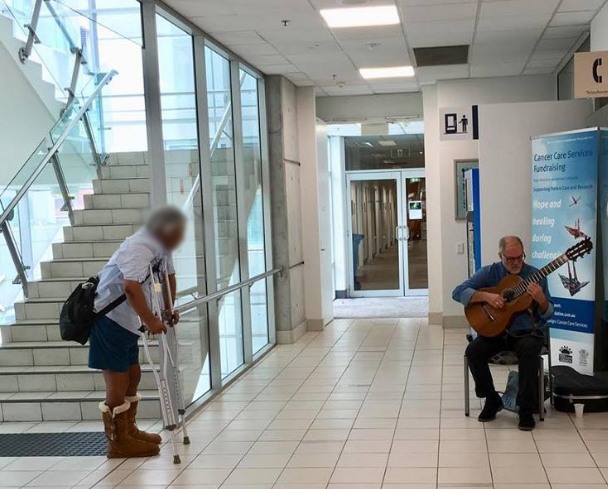
Dr Michael Knopf and a passing patient on level 4, Joyce Tweddell Building, RBWH, September 2024.
“This photo is from a few years ago. I spoke with this gentleman after he had been listening for some time. The photo was taken by a SWP team member. We all had a lovely chat and he was really happy to have music where he was having treatments.
This past week at SWP in the Royal Brisbane and Women’s Hospital:
This is one of the areas the SWP musicians perform for patients and family, staff and visitors. It’s in a little niche across from 2 sitting areas near the elevators and down from the entry way in Oncology. Some of us also play in the chemotherapy ward for patients and staff.
People are all different of course- as individuals and coming from many parts of the world. I’ve met Aussies from everywhere, but also Japanese, Chinese, Korean, Kiwis, Brazilians, Paraguayans, and also many from North America and Europe.
It’s good to keep in mind that often the patients are quite ill feeling from their disease or medication. I play Bach, improvisations, Beatles, Bossa Novas and classical repertoire too. This week I played much softer than I normally do as many were unwell and closing their eyes to deal with the pain and discomfort. They do hear the music and will very often thank me as I get up to go to another spot.
This week we had: the lady so ill that she never opened her eyes in a grim-and-bear it face; the lady with the scarf on her head cheerfully chatting to the snacks gentleman but in turning her head to one side in the conversation one notes the red and tear filled eyes; the lady from Papua New Guinea who claps carefully but enthusiastically when I finish “Love Me Tender” and who later when I’m in another part of the ward walks by to tell me I’d buy your CDs!
The old gentleman who sits quietly munching a cookie while his wife sits next to him reading and, hilariously, the old fellow from Eastern Europe who, as I am playing, makes a blowing noise from his mouth. I turn to see what’s going on and apparently there was part of his sandwich caught in his dentures. He had taken them out, was holding them and blow the debris away!
It was not appropriate for me to laugh aloud.
A little while later, I place my guitar under my right arm and pick up my foldable chair and depart. Around the ward to the hallway and exit, several nurses smile and say “thank you” or “beautiful”. (I think they meant the music?)
Live, sensitive and caring music is denied most patients in the world. It seems to me to be a highly impactful accompaniment to medical treatment.”
Food and moodis one of the drivers at Echo Valley Farm of their agroecology – to sell food directly to the eater in their Four Goods framework. Good for the land, good for the animal, good for farmer, good for the eater.
Healthy food choices help us avoid erratic blood sugar levels and associated mood swings. But many of us have experienced the 3 o’clock dip in the afternoon where you find yourself irritated, fuzzy and trouble focusing. You would love to find a corner and go to sleep, but there is no time. How about a coffee or a chocolate bar? Most of us instinctively reach for sweets or caffeine to give relief from the morning sluggishness or afternoon slump. We use sweets as a way of helping ourselves through stressful times. Those strategies might help, temporarily, but there is a downside to these methods. Many people choose sweets and caffeine as a substitute for proper nutrition. Poor eating strategies affect our brain chemistry and cause fatigue, apathy, apprehension, edginess and the blues. The brain has first call on the body’s available supply of nutrients, therefore, the first effects of nutritional deficiencies are often mental symptoms.
Research shows that low levels of protein in a diet have a negative impact on the body’s production of neurotransmitters, which directly affect our mood and energy. Deficiencies in vitamins B1, B6, C, A, essential fatty acids, folic acid, niacin, magnesium, copper and iron also affect the fine balance of these neurotransmitters. Vitamin and Mineral Deficiencies In Food That Impact Your Mood:Vitamin B1 or Thiamine is drained by simple sugars. B1 helps convert blood sugar into fuel. Without it, we can experience fatigue, depressive symptoms, irritability, anxiety, memory problems, insomnia and even thoughts of suicide.Research has found a strong correlation between vitamin B6 deficiency and depressive symptomsA lack of B12 can lead to mood swings, paranoia, irritability, confusion, dementia, hallucinationsFolic Acid assists in the creation of many neurotransmitters and can cause fatigue and dementiaLow levels of Vitamin C can produce depressive symptoms.
Building Resiliency Through Food & Mood
1. Eat regularly. Smaller balanced meals are preferable to large meals 2. Use exercise or stretching to increase energy and lift the ‘fog’ 3. Eat protein earlier in the day – we metabolize proteins in a way that we get the full energy from them up to 5 hours later 4. Include fish in your weekly diet as the essential fatty acids they contain increase energy and improve mood 5. Eat complex carbohydrates such as whole grains and vegetables instead of simple sugars found in chocolate bars and candy, which give the quick high but a low plunge 6. Don’t confuse thirst with hunger. Drinking a cool glass of water can boost energy in the middle of the afternoon slump 7. Avoid food additives such as colorants and preservatives which can have a negative allergic reaction in the body 8. Don’t buy foods high in sugar. If it is not sitting in the cupboard or desk drawer you are less likely to make snap decisions 9. Have healthy snacks readily available. Plan ahead and keep them in desk drawers, lockers or even in the glove box of your car 10. A daily supplement may be helpful, but don’t rely on it to replace healthy eating. Eat a variety of foods.
We have all heard the saying ‘We are what we eat’, but most of us connect this with the body’s physical reactions. Our brain is just as dependent on the food that we consume. Healthy food choices help us avoid the erratic blood sugar levels and associated mood swings, which can keep us mentally healthy.
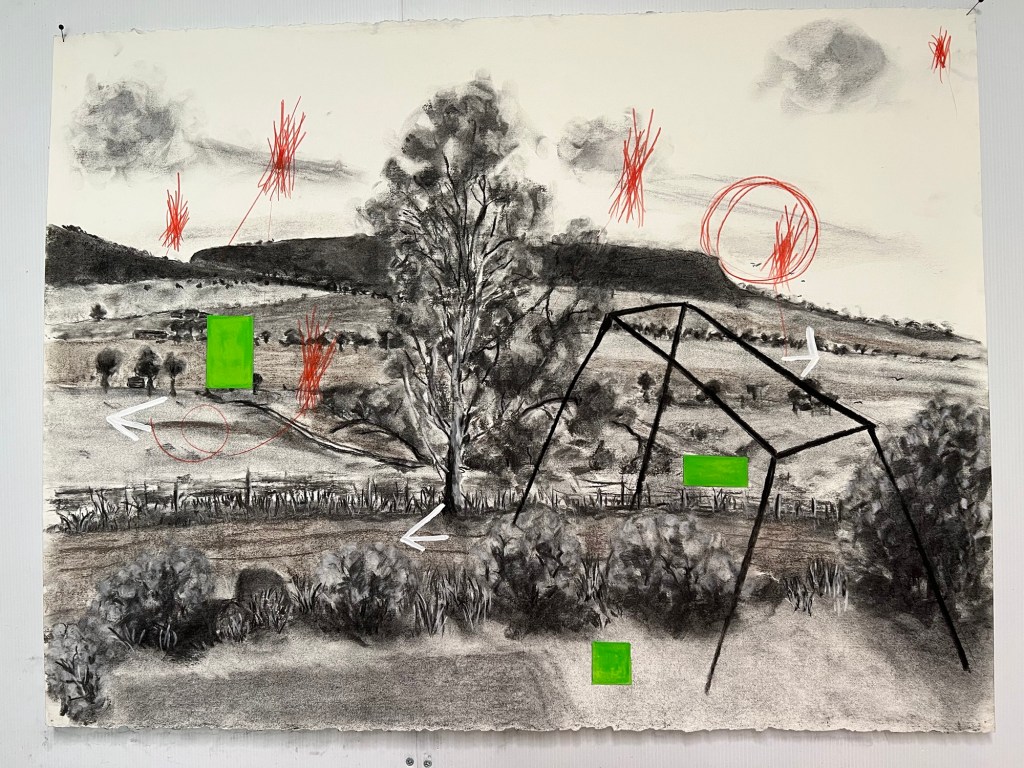
“Compound Fractures” Charcoal, red pencil, guauche, gesso.
This drawing of mine was part of a series of 4 that was included in the @echovalleyfarmer #4goodsfieldday on August 31. Those 4 were not listed for sale ( other artists’ works from Toowoomba and Warwick were) but this one – Compound Fractures – caught the eye and heart of a couple who are heavily invested in Regenerative agriculture as Randal and Juanita are. They felt that this drawing was both descriptive and symbolic of what has been happening to the landscape and the soil in particular in Australia over the past couple of hundred years particularly with the impact of industrial farming practices. To be honest it was hard to farewell this work but this morning I did part with it as it goes to a home where eyes and hearts will be engaged by my drawing that is partly representative of what I have seen as a learning “ patient, attentive observer” SOLD
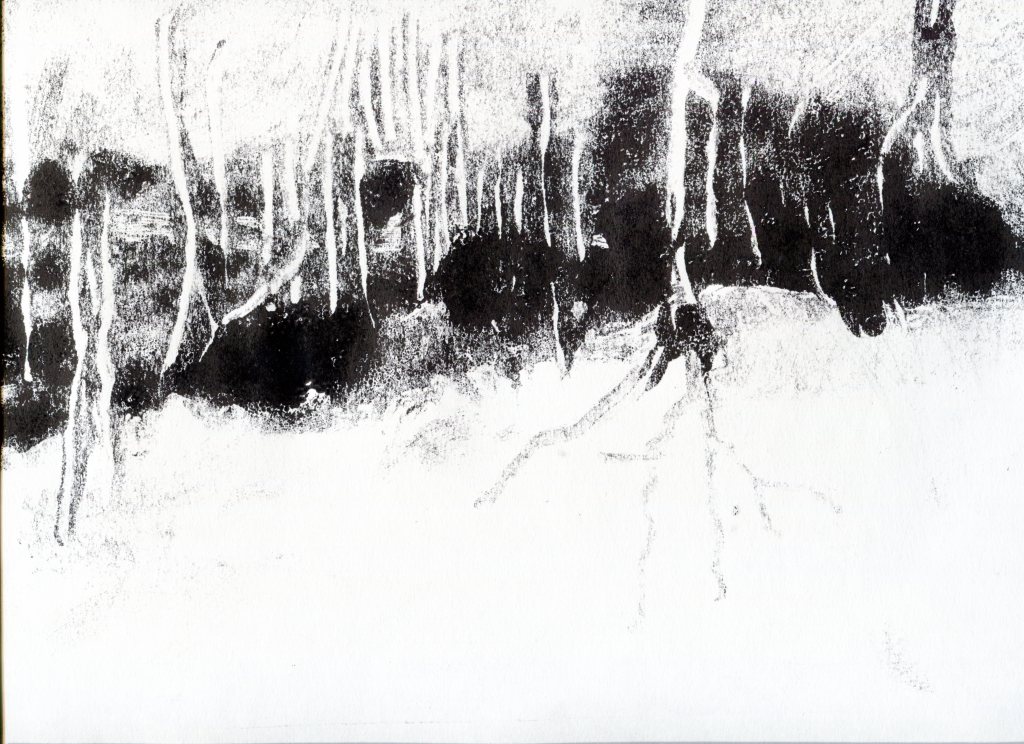
“What Remains #3 Chacoal, ink, red pencil, guauche on arches paper “What Remains #2” Charcoal, ink, gauche, “What Remains #1” Charcoal, chalk, ink on Arches paper.
The remaining 3 drawings are available for purchase. For more information please contact me via psbjugglers@gmail.com
March 1975, Rocket attack debri, Phnom Pehn – Pre Pol Pot.
Photo Credit: Lindsay Nicholls
Administrator -World Vision Medical Team, Cambodia 1974 – 75
Forgiveness is a core value in religion and particularly in Christianity. It can be positive, healing and renewing but it has a history of being over-used, maninipulative and abused to the point of even excluding restorative justice – as in the massive sexual abuse issues in the church in Australia. Thankfully some positive ways forward have been initiated in that particular example. I found the following article a helpful reflection. My experience of working with and in a country of gentle people abused and violated by foreign [ USA ] and malign [ Khmer Rouge] powers begs the question of forgiveness and restorative justice for a whole country.
“In this age of grievance and deadly conflict we can learn about forgiveness through the lens of science that expands what religion and moral philosophy teach us. Social scientists have now been studying the psychological benefits of interpersonal forgiveness for more than thirty years.The act of forgiving, they have found, can have benefits both mental, less anger, anxiety and depression, and physical, lower blood pressure, better sleep and improved immune system. More recently, researchers have been studying whether they can apply what they have learned about interpersonal forgiveness to group forgiveness.The first important aspect of interpersonal forgiveness is that there must be a harm in an interpersonal relationship. Forgiveness begins with a recognition that one has been harmed. In that harm there is pain, resentment, and anger (which are natural responses to harm). Having recognized the harm and the attendant suffering, one then must choose what to do next. The path to forgiveness involves a decision to work through the pain and the suffering by opening up to the possibility of forgiveness.We should be clear that forgiveness is not forgetting or explaining away. In other words, the forgiver can be very clear that they were harmed, that the perpetrator and act(s) were wrong, that experiencing pain and anger is justified (and natural). However, because anger and resentment are corrosive to well-being, liberating oneself from the difficult experience may require offering beneficence or goodwill or compassion to the offender, but not necessarily for the offender.Once a decision to move toward forgiveness has occurred, the next is the work phase. In this phase, the forgiver tries to better understand the causes and conditions that contributed to the offender acting as they did, and through this understanding the forgiver tries to see the offender in their full humanity. It also involves recognizing the full depth of the harm and pain and accepting it.Forgiveness may result in reconciliation, but it does not need to. It also may result in altruistic feelings such as empathy and compassion toward the offender because by going through the forgiveness process the forgiver recognizes the humanity of the offender and the suffering and the challenges he or she must have experienced to lead them to act in the way(s) they did.Group forgiveness is when an identity group (e.g., team, company, religious organization) establishes norms and values that promote forgiveness, make public statements and commitments that lead to or are consistent with forgiveness, and establishes structures that support forgiveness. For example, a truth and reconciliation process following strife between two groups is an example of a structure that supports forgiveness.Reconciliation is coming back together after a breaking apart. Forgiveness might lead to reconciliation, but it is equally possible that forgiveness leads to strong feelings of compassion and the recognition that reconciliation would likely lead to more harm. Pardoning is typically a legal term that suggests a legal remedy for a prior transgression. Forgiveness does not pardon or excuse; the process of forgiveness involves fully appreciating that harm was done and accepting the consequences of that harm, and then making the decision to move beyond it. Accommodating intimates adjusting one’s point of view so that it is closer to another’s. While better understanding the causes and conditions that might have contributed to the offender offending is part of the forgiveness process, it does not involve accommodating an alternative understanding of the harm itself (e.g., the offender’s rationale).”
Seasonal Affective Disorder (SAD) is a type of depressive disorder that coincides with the change of seasons. It most notably occurs from late Autumn to Winter. It tends to impact females more frequently than males and can range in intensity from mild to more severe symptoms. The most common symptoms are:
Feelings of loneliness and isolation Social withdrawal Changes in sleep patterns Feelings of detachment and/or feeling emotionally numb A change in appetite Craving foods high in carbohydrates Feeling agitated Drinking more alcohol/substance abuse School or work problems Weight gain or Weight loss Feeling lethargic / having low energy Feeling teary Feeling hopeless and/or worthless Suicidal thoughts or behaviour
Those people who are affected by SAD often feel that it has impacted all areas of their lives, including their relationships, work, health and well-being. When these symptoms manifest, people can often feel as if they are unable to work or function daily.
Managing SAD The best way to manage the Winter Blues is to manage the symptoms. As with any mental health issue, symptoms will vary from person to person. Some individuals will respond well to certain types of interventions, whilst others may need another type of intervention or approach. The main thing is to strive for balance; if one method doesn’t work, then try another.
Seek Balance Mental and physical health often improve when life is back in balance. The three areas of our lives we need to pay attention to are our minds, our physical body and our spirit (emotions). Try to include activities in your daily life that fit into these three categories.
Some Suggestions are: Eat foods that nourish your body including sufficient vegetables and fruits (think a minimum of 2 servings of fruits and 5 servings of vegetables per day). Are you eating whole grains and staying away from highly processed foods?
Are you regularly interacting with others in your life whose company you enjoy?
Have you been moving your body regularly in ways that bring you calm and satisfaction?
Even as little as a few minutes of mindfulness practice each day can help to lift your mood and induce feelings of calm and well-being.
Prioritise your daily tasks Your ever-increasing to-do lists aren’t going to disappear, however, developing strategies for dealing with them will make them seem less onerous. Create a list with tasks ranging from the simplest tasks to the more complex ones. Set a goal of achieving at least 3 tasks each day from the list; a few more if you are able. At work, if you have more than a few projects going at one time and feel overwhelmed, divide each project into manageable segments that can be done in one sitting.
Talk about it The Winter Blues or SAD is a disorder that will only worsen if symptoms are stifled and not spoken about. Speaking with trusted friends, and family, or joining an online community who are also experiencing it can be helpful, however speaking to a trained mental health professional is the most helpful approach.
times when energy sap is gone when corners distance in a far off land or sleep arrives in bits and pieces and despair stays at home as part of being while dust settles.
Peter Breen
Below are five tips to help you enhance motivation when you feel like giving up:
Be grateful If there’s an instant way to defuse those feel bad vibes, it’s gratitude, and even if it doesn’t directly change your situation, it changes your perspective. A well know quote is “Great things happen to those who don’t stop believing, trying, learning and being grateful.”
Being grateful shifts you from a dwelling, passive and stagnant mode into a receptive one. Being in the here and now and catching that glimmer of light through the darkness. From there you’re open to new ideas, hope and inspiration. Whatever you’re going through, it’s not about discrediting it or trivialising it. Breakups are rough. Heartbreak can be agony; physically and emotionally. But you will always have something to be grateful for. It could be something tiny such as a song on the radio, a call you had with a friend yesterday.
Look to others as examples This is all about finding evidence that ‘if they can do it, I can too!’ It can be helpful to find examples of other people who have come from a similar place and are now thriving. You’ll often learn that for those people, it was also a process, but seeing them a few steps ahead of you or even miles ahead, can give you the fuel you need to know it’s possible for you too. Ultimately, we all have the same potential regardless of academic intelligence, appearance, wealth or background.
Rewire and reprogram your brain What this means is learning how to identify and change your internal and subconscious beliefs to heal. Say you just can’t seem to get over your ex despite doing everything in your power. You’ve read all the books and all the articles and nothing seems to help. Even though on a conscious level you want for the pain to be over more than anything, deep down, some of the beliefs you could be experiencing might include not feeling good enough to be alone or in new relationship, being scared of your identity without your ex, not wanting to let go of your ex or being afraid of change. With health, it could be not believing you’re worthy of having perfect health, being scared of what would happen if you were healthy, feeling unsafe in the world, being afraid to speak your truth, not believing that you’re capable of taking care of yourself. Ultimately the process of rewiring is individual and allows you to tap into those deep rooted and often insidious reasons that are keeping you stuck – usually they’re enlightening to discover. It’s then about calming down your limbic system to get into a parasympathetic state as opposed to a fight or flight one to then begin to rewire those old patterns and turn them into new ones that will support getting over your ex, getting back to perfect health or whatever situation you’re looking to bounce back from. This process includes a highly repetitive blend of elements such as affirmation, visualisation and action.
Just DO something Depression is the worst kind of emotion because it’s passive. There’s no energy behind it. Nothing is impossible but it can be very tricky to go from feeling depressed to absolutely elated in a short space of time. No amount of affirmations can make your subconscious believe it. But aiming just a few rungs up the emotional ladder is more do-able. Even moving from depression to frustration or anger is an amazing step, because those emotions have energy behind them. You can do something with them. To ignite that emotion climb it requires you to create energy within your body. Do jumping jacks, go for a walk, cook, clean, call a friend, do something which makes you feel like you’re ‘doing’ something. Movement is a great one. A brilliant definition of emotion is ‘energy in motion’. It’s amazing how when we resign ourselves to staying stagnant, we embody that physically and emotionally. We feel tired. We feel worse inside. But just a little movement or environment change can be all we need in that moment to shift and get an extra rung up the emotion ladder.
Be the inspirer you need Imagine that your younger, childlike self is feeling how you’re feeling. Going through this experience. What would you do or say to them to help them through? To keep them feeling inspired, safe and nurtured. Also know that whatever challenges you’re going through, it will pass. Feel it, be ok with it, know that it’s a human experience, know that like a captain steering a ship sometimes you have to adapt and go left, sometimes you have to go right; it isn’t a linear path. Do what you can to keep yourself moving forward a tiny step every single day.
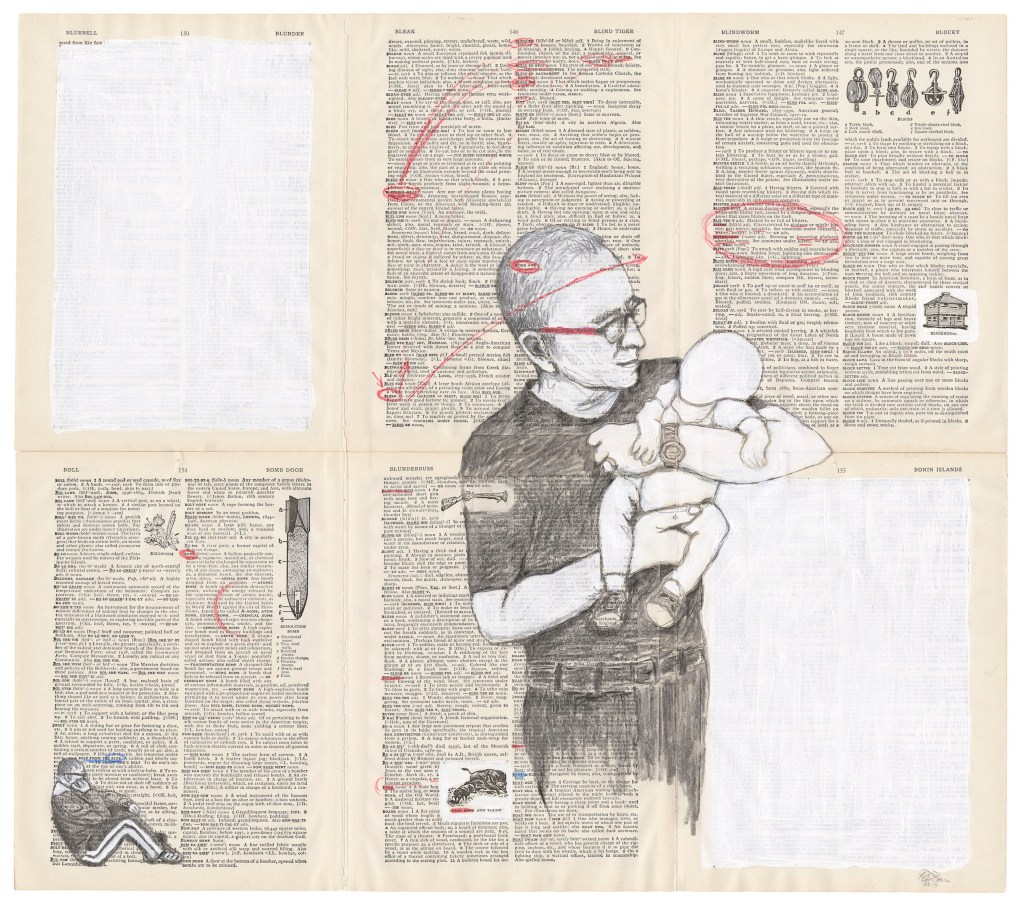
Blessings of the blithesome Charcoal, ink, pencil on old book pages. Peter Breen 2017
I apply all of these during my daily life and have done over the years as the black dog circles occasionally. One of the most effective for me is the regular [daily] exercise and never taking my smart phone or lap top to the bed room. I am currently reducing smart phone/app time significantly. Peter Breen.
When feelings of sadness or feeling ‘down’ last more than a few weeks, and start to impact your daily life, it may be a sign of depression. It can lead to feeling irritated, hopeless or worthless, and affect energy, sleep, appetite and relationships. Depression is a mood disorder that can be caused by a variety of factors, including genetics, stress from life-changing events, serious illness, substance use and even certain medications. Depression can range from moderate (having a significant impact on daily life) to severe (making daily life almost impossible). Currently, men are less likely to seek help for depression, and 3x more likely to die from suicide. Below are some strategies which may make a difference:
Mind Your Thinking Reality check your thinking so that overly negative thought patterns do not become a habit. Your mindset matters and can affect your health. Talk to yourself like you would talk to a friend or how your favourite coach or teacher would talk to you.
Set “SMART” Goals Achieving goals can boost your mood. Setting goals that are unrealistic can lower your mood and sense of self-efficacy. Set “SMART” goals that are specific, measurable, achievable, relevant and time-bound. If you are having trouble meeting your goals, try making them smaller or asking for help. Small steps can lead to big change.
Do Things on Purpose Find activities that give you a sense of meaning. Do not avoid all uncomfortable situations. You can do hard things.
Get Active 80% of Australian men believe physical activity has a positive effect on their mental health. Physical activity triggers feel-good endorphins, while reducing symptoms of stress, anxiety and mild-to-moderate depression. Research shows that 30 minutes of moderately intense activity 2-3 times per week can help if you keep it up for at least 9 weeks. Make moving your body a habit. Remember, any activity is better than none.
Sleep Better Learn what you can do to improve your sleep: avoid screen-time one hour before bed, have a consistent wake time, and reduce your caffeine intake. Manage your worries during the day so your thoughts don’t keep you up at night. Aim for 7-9 hours of quality sleep per night.
Eat Healthier Choose whole foods more often like fruits, vegetables, whole grains and lean proteins. These foods are packed with vitamins and nutrients essential for brain health and can boost your energy and overall sense of wellness.
Drink Less Many people who experience depression may turn to alcohol for comfort or fun. However, alcohol is a depressant drug. It slows down parts of your brain involved in thinking, behaving, and even breathing. Long-term overuse of alcohol can trigger or worsen symptoms. Any reduction in alcohol use is beneficial for your physical and mental health.





















 Peteskibreen's Blog